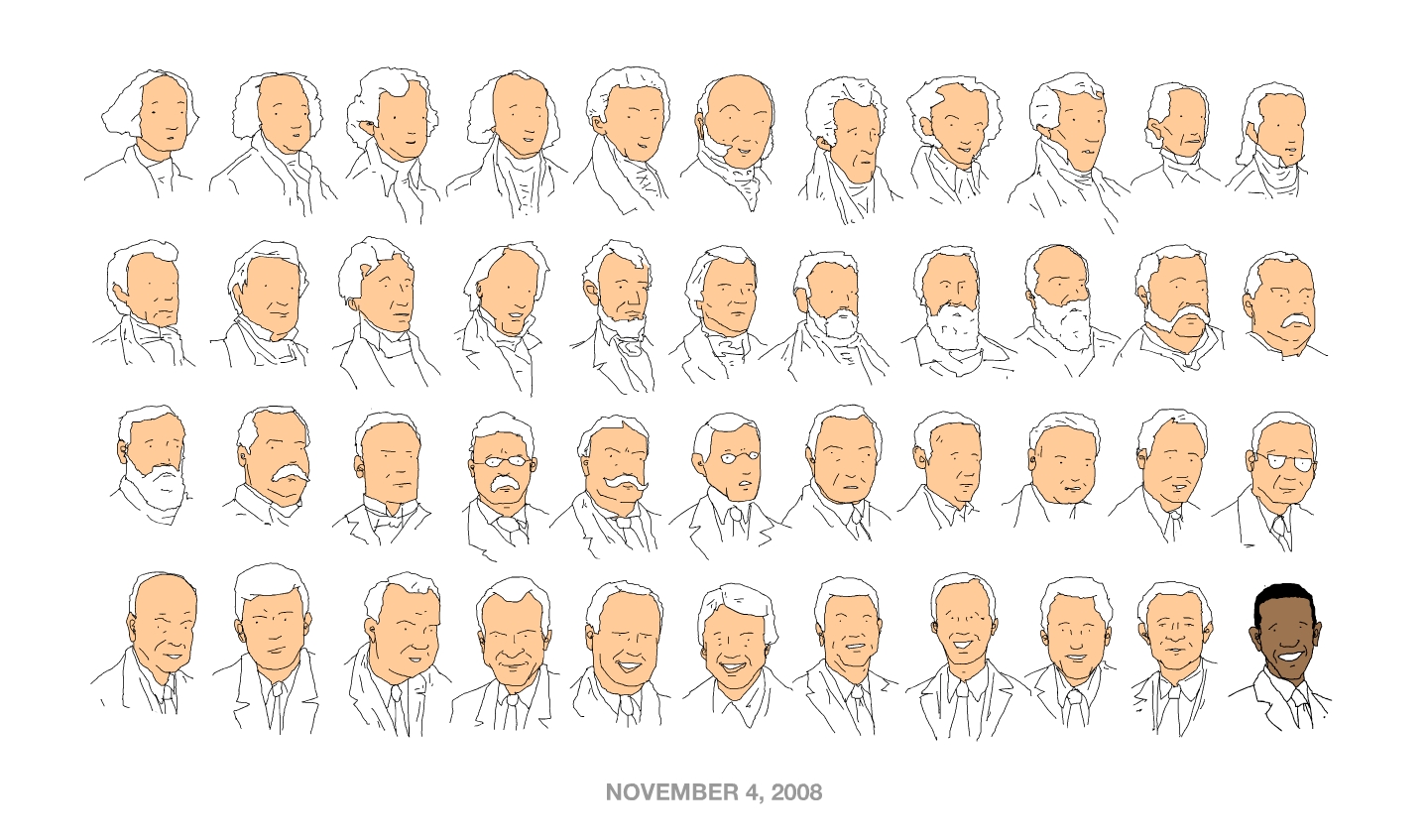
"His lacklustre attorney-general Alberto Gonzales, who was forced to resign in disgrace, was only the most visible of an army of over-promoted, ideologically vetted homunculi."

from "The Frat Boy Ships Out" The Economist 1/15/09
Showing posts with label same-sex marriage. Show all posts

Saturday, November 8, 2008

We Hold These Truths to be Self-Evident

The Declaration of Independence of the Thirteen Colonies
In CONGRESS, July 4, 1776
The unanimous Declaration of the thirteen united States of America,

When in the Course of human events, it becomes necessary for one people to dissolve the political bands which have connected them with another, and to assume among the powers of the earth, the separate and equal station to which the Laws of Nature and of Nature's God entitle them, a decent respect to the opinions of mankind requires that they should declare the causes which impel them to the separation.

We hold these truths to be self-evident, that all men are created equal, that they are endowed by their Creator with certain unalienable Rights, that among these are Life, Liberty and the pursuit of Happiness. --That to secure these rights, Governments are instituted among Men, deriving their just powers from the consent of the governed, --That whenever any Form of Government becomes destructive of these ends, it is the Right of the People to alter or to abolish it, and to institute new Government, laying its foundation on such principles and organizing its powers in such form, as to them shall seem most likely to effect their Safety and Happiness. Prudence, indeed, will dictate that Governments long established should not be changed for light and transient causes; and accordingly all experience hath shewn, that mankind are more disposed to suffer, while evils are sufferable, than to right themselves by abolishing the forms to which they are accustomed. But when a long train of abuses and usurpations, pursuing invariably the same Object evinces a design to reduce them under absolute Despotism, it is their right, it is their duty, to
throw off such Government, and to provide new Guards for their future security.


* * * * *

I am one of those liberals who people laughed at for suffering high levels of anxiety throughout the fall as the presidential campaign wended its lugubrious way toward an end that less worried people felt was comfortably inevitable. Reason suggested, the closer we got to November 4, that there was no way McCain-Palin could win, but I found it absolutely terrifying to have to contemplate even a remote possibility that we would find ourselves dealing with four disastrous years of an administration headed by a man who bragged about voting with George Bush 90% of the time, who said that he would be willing to stay in Iraq for 100 years, if that is what it took, and who asked us to accept, as a serious candidate for the Vice-Presidency, a woman whose past (and, as it turned out, present) is littered with ethically questionable behavior, whose politics are to the right of George Bush, whose temperament is meaner than McCain’s, and whose intelligence—or, at the very least—knowledge, is vastly inferior to what is needed to inspire confidence that she could begin to handle even one of the challenges that faces America’s next president.

In part my anxiety was a simple matter of my profound belief that we cannot survive as a stable country if there aren’t dramatic changes in both foreign and domestic policy, but at least equally disturbing to me was the prospect that I was going to have to face the fact that a majority of people in this country are capable of believing that the deliberate propagation of fear and hatred is an appropriate means of conducting a campaign in a so-called civilized world, that lies and innuendo are equally acceptable bases for making decisions as truth and reasoned explanations backed by facts are, and that taking direct action to fix the problems of the world is less important than keeping someone with a funny name out of the presidency. I tend toward cynicism, and I am seldom surprised to discover that people are driven by ignorance and selfishness rather than by logic and a vision of a better future achievable only by commitment to long-term goals that require short-term pain and sacrifice. Despite that baseline bias, I never seem to give up the hope that better nature will prevail and that we will awake one day to find ourselves living amidst the flourishing embodiment of the original vision of democracy that was enshrined in the constitution more than 200 years ago. Anxiety was the inevitable outcome of the roiling clash in my head between my hope of seeing some portion of my ideal realized and my fear of a reality that would reduce the achievement of my ideal to a laughable pipe dream.

The official declaration, at about 11 p.m. EST on Tuesday, that Barack Hussein Obama would be the next President, was, for me, a moment of great relief and joy. No one could miss the historic nature of the moment, of course, and my happiness was precisely that happiness: the knowledge, for at least one day, that the ideal is attainable, that reason and sanity do sometimes prevail, and that maybe people—a lot of people—aren’t nearly so scared, short-sighted, and foolish as I fear them to be. I have on my computer desktop this picture, created by David Sirota (a Denver based political writer) from a photo he took at the Barack Obama rally that drew 100,000 people in Denver on October 27, which seems to me to encapsulate the moment beautifully. The sun is out, the colors are bright, light reflects on the gold of the dome. The huge crowd stands as one, looking in the same direction, carrying the same message, hoping for the same thing. A metaphor. Sirota himself describes the picture as a picture of Democracy, more than a picture of Barack Obama.


Many other images seem to encapsulate the effect of the moment. This mosaic of next-day newspaper front pages forges another vision of unity across the country.

This photo of the next first family tells the story of a new future, completely different from what has gone before:

It promises not only a world of a different color, but a younger one, lit by an unknown, but definitely glamorous light. I got the picture from The New Zimbabwe Times, and its appearance there along with the full text of Obama’s victory speech, illustrates the scale of the influence of the choice, shows that a decision that important that far away says something significant about how small the world is, and about how many others have hopes similar to mine that America will set itself right again.

This cartoon, by Patrick Moberg, tells a similar story: the future is dramatically, strikingly different from the past.

Given the past, especially the recent eight-years’ past, dramatically different is strikingly welcome.

Finally, the image that first occurred to me as speaking for the moment is not a new one, but an old one. The Doonesbury cartoon from September 2, 1974 speaks volumes about hope:


The symbolic uncovering of one of the nation’s most famous symbols serves as an image of the potential restoration not only of the executive branch to its rightful status, but also of democracy itself, and, as we have already seen, of the standing of the nation in the eyes of the world. These are all potential, of course; it remains to be seen whether the hope will be justified, but for now, the sun is out.

Tuesday, November 4, 2008, was a great moment. A historical, once-in-a-lifetime, once-in-the-history-of-a-nation moment.

I was deeply distressed, therefore, to have the joy of that moment dramatically undercut less than one day later.

The celebration wasn’t even over yet the next day before we had to accept the news that Proposition 8 had passed in California. This was perhaps unsurprising—I had said all along that there was only a chance that it would fail—but it was a deep disappointment nevertheless. Bans on same-sex marriage passed on the same day in Arizona and Florida as well as in California. These measures are no more reasonable, democratic, or humane in Arizona and Florida, but they are perhaps more easily understood. Arizona went, of course, for McCain in the Presidential election by a nine-point margin, and though Florida went for Obama, the margin of victory there was small: 51% to 49%. In California, however, the presidential vote was nearly 2-1 for Obama: he won by 24 points. The results in Arizona and Florida are disappointing, but more or less consistent; the results in California are harder for me to accept because they stand as a glaring and sad contradiction. The results in California serve as an indisputable reminder that my fears about the potential of our worse nature to prevail cannot be completely mitigated by the election of Barack Obama. The results in California demonstrate that people are not yet mostly reasonable, that people can, and do, hang onto contradictory beliefs, and that people can, and do, live comfortably with priding themselves on their open-mindedness for their acceptance of one human characteristic, skin color, while concurrently discriminating against someone else for another human characteristic, sexual orientation.

A different set of images tells this story (I encountered these at Andrew Sullivan’s blog at The Atlantic). One narrative line has to do with new or expanded hatreds that will arise out of the aftermath of the failure of the No-on-8 effort. This photo shows an early protest against the Mormon Church, whose members supported Proposition 8 to the tune of tens of millions of dollars:


This irony is a sad one: the claim the sign makes is largely true (though it conflates the Mormons with the entire pro-8 movement, which is neither accurate nor reasonable); several highly controversial ads did, in fact, use children as a means of escalating fear—in at least one instance, without the permission of the parents. Check out two here and here. Certainly the pro 8 arguments relied heavily on fear and hate: “It has already happened” (with the “it” not specified); “Save Marriage”; “Protect the Children”; these and other ominous phrases suggested none too subtly that catastrophic harm would come to American culture as we know it. This kind of fear-mongering naturally obscured the fact that there are already 17,000 married gay couples and a vast number, married and unmarried, who have adopted children. None of these has caused a cataclysm. So the protest in the picture is understandable and to a large degree justified; I, too, was enraged by the fact that the Mormon church, working in a heavy-handed manner out of Utah could and did intervene in a decision to revise the California state constitution, and I was even more enraged that their attempt to influence was so effective; but I am saddened by this sign because it is a tangible reminder that the inevitable result of a successful campaign of hatred is hatred offered in retaliation. This is why hatred is so bad: it regenerates in widening circles.

Another image, a political cartoon by Tom Toles, drawing for The Washington Post, demonstrates eloquently why it is difficult not to be angered and frustrated by the irony of California’s November 4 decisions. His cartoon refers to Proposition 8 and Proposition 2, an animal-rights measure:

How can one not be angered and frustrated by the realization that although California voters have risen up to accord equality to racial minorities, they have, at the same moment institutionalized a hierarchy in which chickens are valued, in some ways, more than homosexuals?

I resent the hypocrisy on abstract philosophical principles of fairness, but I also resent it because I have had, for 30 years, a very good friend who is gay. He and his partner have been together as a couple for coming up on 20 years; very nearly as long as my husband and I have been married. My friend and his partner have a stable relationship, they own a house for which they regularly make the mortgage payments, they have long been gainfully employed, and they pay taxes. In the past few years, they have adopted two children who were not wanted in a lot of more traditional households because they are both of mixed race. My friends have worked with their accountant to ensure that the children will be cared for financially no matter what happens to the two fathers, and they have worked together tirelessly to make good decisions about how to raise their children to be healthy, happy, and safe. My friend’s partner has given up his job in order to stay home, because they believe that having a stay-at-home parent is the best way to ensure that their children are well-raised. I admire my friends for working at, and achieving, the kind of relationship and the kind of family that we idolize, in this culture, but which we all too often fail to achieve. I resent deeply the implication that my friends are viewed as less deserving of public concern than chickens are.

The conflict and contradiction arise from ignorance, of course. Those who so fear the specter of same-sex marriage that they are driven to extreme measures to codify bigotry are mired in the twin false beliefs that homosexuality is a matter of choice, and that children exposed to homosexuals, especially if the “choice” is validated by formal public approval, will be convinced to choose a homosexual lifestyle. That ignorance is so far immune to any reasoned argument that points out, for instance, that straight people never experienced a moment themselves in which, faced with a choice, they decided to be heterosexual, that research shows that children of gay parents are no more likely to be homosexual than are children of heterosexual parents, or that modern science has demonstrated, based on studies of twins, that the highest predictor of homosexuality is genetic and the second highest is a trauma, such as abandonment by the parent of the same sex, when one is very young—before reaching school age. All current information indicates that there is at no point in anyone’s life a chance to simply choose, consciously and willfully, one’s sexual orientation. (Another excellent source of documented information is the book Everything You Never Wanted Your Kids to Know About Sex But Were Afraid They’d Ask, by Justin Richardson and Mark Schuster.) People who oppose rights for homosexuals, however, do so because they hold old, deeply rooted beliefs, almost always based in religion, and because they are unwilling to try to find out more, because they are afraid that their ideas might prove to be wrong. These people don’t know my friends in California, and they don’t want to know them, because to know them really might turn out to be to love them.

The effort, then, thrives on a deliberate fostering of ignorance, and that effort has led to the formalizing of hypocrisy in the California constitution itself.

California’s constitution states:

(b) A citizen or class of citizens may not be granted privileges or immunities not
granted on the same terms to all citizens. Privileges or immunities granted by
the Legislature may be altered or revoked.

Proposition 8 states:

SECTION 1. Title

This measure shall be known and may be cited as the “California Marriage Protection Act.”

SECTION 2. Section 7.5 is added to Article I of the California Constitution, to read:

SEC. 7.5. Only marriage between a man and a woman is valid or recognized in California.

These sixteen words now enacted into law effectively negate the principle in the California constitution that all men are created equal and as such shall not be denied privileges granted to others, and in so doing they turn California away from the effort to realize the vision of the founding fathers.

A 24-point Obama win in California accompanied by a simultaneous 4-point homosexual loss is a 28-point signal that America is not yet ready to live all the way up to the promise of the Constitution. We’ve come a long way—far enough that someone who would once have been counted as 3/5 of a person will now assume the reins of the most powerful position in the nation—possibly in the world—and will do so with the legal blessing and whole-hearted support of a significant majority segment of the population, a majority not only of the electoral college but also of the voting population at large, a population comprising men, women, Caucasian, African-American, Latino, Asian straight, gay, young, old, rich poor, and a wide variety of other demographic identities. That’s a long road to travel, and we have accomplished something not to be trivialized; nevertheless, the Proposition 8 results remind us that we have not traveled far enough, not even in the states where the Obama result indicated the biggest margins of victory of reason and fairness over bigotry and discrimination.

I have been picking on California because the outcome of Proposition 8 there provides such a dramatic example of our capacity to fool ourselves into hanging on to wrongs, but the three states that enacted anti-gay-marriage laws in the 2008 elections were numbers 28, 29, and 30. The problem is widespread, and we need a widespread movement to counter it. Sadly, the man who has himself become the icon of social progress and who is now well-positioned to lead such a movement is himself a part of the problem. Barack Obama has made it known publicly that though he opposes discrimination, he also opposes same-sex marriage, believing instead that marriage should be between a man and a woman. He has not, so far as I am aware, been pressed to explain the contradiction in his thinking beyond saying that he believes Civil Unions provide sufficient rights.

Obama has demonstrated himself to be an extremely intelligent person; I have to think that he is aware of the irrationality of the ideological fence he has chosen to walk on this particular issue. I would like to hear his explanation for that choice. I would like to know whether he truly knows that if we are to eliminate discrimination, then we must offer same-sex marriage so long as we offer different-sex marriage and only took the position he took because he feared he could not otherwise be elected, or whether in fact Obama suffers from the same self-deluding hypocrisy that we have just seen out of many Californians who have managed to convince themselves that it is possible to proclaim oneself an advocate for African-Americans and chickens but not for homosexuals and still claim to be an open-minded defender of the constitution. I would like to hear Obama answer a question such as this one: “If Civil Unions serve sufficiently to protect the rights of gay people, then presumably, given your stance on equality and non-discrimination, you believe that Civil Unions also serve sufficiently to protect the rights of straight people. Why, then, are you married? And if you believe, as it seems you must, that marriage confers some further benefit that you deserve and chose to take advantage of, then why do homosexuals not deserve the same as you?” I would like to see all those who try to walk the line between bigotry and enlightenment answer the same question; I would like to see it made clear that there is no middle road. One either believes in equality or one does not. A stand for equality for some but not for others is, by definition, a stand for inequality.

We have made much progress; the concrete sign of that progress that we enacted this week by the long-overdue step of electing an African-American President is of immense historical, philosophical, and emotional value, and is justifiably a source of great joy for those who look for mankind’s better nature to assert itself more and more in years to come. Barack Obama ran on the narrative of hope: he promised us that change is possible, and that we can enact it if we but believe and then work for what we believe in. What I hope for now is that President-Elect Obama will have learned something from his own magnificent experience of what it feels like to find oneself on the far side of the wall of bigotry, with the crumbled remains of that wall on the ground behind him. My hope is that Obama will be able to lead the next charge of those who believe and those who are almost ready to believe in the next effort to eliminate one of the last remaining socially and legally acceptable prejudices. The hope I have for soon-to-be President Obama is that he will show us how to take one more serious step toward achieving the equality for all mankind that the men who founded the United States of America proclaimed as one of the fundamental truths of human existence.


Saturday, October 25, 2008

Obama, Keillor, Kristol, Same-Sex Marriage and Me

A few weeks ago, William Kristol wrote a column for the New York Times in which he urged the McCain campaign to take what he [Kristol] called the “very simple” step of attacking Barack Obama on the issue of what is, according to Kristol, his core problem: excessive liberalism. Here’s the quotation:


The core case against Obama is pretty simple: he’s too liberal. A few months ago
I asked one of McCain’s aides what aspect of Obama’s liberalism they thought
they could most effectively exploit. He looked at me as if I were a simpleton,
and patiently explained that talking about “conservatism” and “liberalism” was
so old-fashioned.

Maybe. But the fact is the only Democrats to win
the presidency in the past 40 years — Jimmy Carter and Bill Clinton — distanced
themselves from liberal orthodoxy. Obama is, by contrast, a garden-variety
liberal.
This is a familiar Republican tactic; Democrats have been painted as “too liberal” for years. Obama provides what appears to be extra grist for the mill because in January, the National Journal, which does a statistical assessment of senators’ voting records and awards a score indicating a ranking, voted Obama “the most liberal senator” for 2007. In 2007, Obama voted in line with the liberal position more often than 95.5% of all senators. While the National Journal article gives an overview of how it arrives at the numbers, it does not give a detailed assessment of what the assessors and statisticians consider to be “liberal”—even in the associated article “Methodology: How the Vote Ratings are Calculated”--or how the liberal-ness or conservative-ness of a given bill is determined; nevertheless, such a ranking system presumes that there are attitudes and values that are inherently “liberal” and that those attitudes are identifiable and so are reflected by a voting record.

The article does give some idea about issues that are considered liberal, for the purposes of making this assessment: the issues mentioned are abortion, taxes, immigration, and national security. I am assuming now, but it seems probable that the liberal positions on these issues would be pro-choice, raising taxes in order to pay for public services, allow for illegal immigrants to remain in the US through some controlled process, and oppose so-called national security measures such as warrantless phone-tapping. It is, furthermore, presumably these sorts of positions to which William Kristol, and others like him, object.

But consider what attitudes are suggested by support of these, and similar, positions. To be in favor of the right of a woman—or couple—to choose an abortion is to be in favor of people having power over their own bodies and of a decision that will dramatically alter the direction, substance, and quality of her own life. To be in favor of raising enough tax money to pay for public services (health care, social security, and so forth), to be, in other words, opposed to the idea that you ensure that the rich get as rich as possible so that their wealth will “trickle down,” is to believe that we have an obligation to each other, that although we live in a country which holds, as a fundamental belief, the idea that the individual matters, we also believe that in order for all individuals to thrive, they will require help from time to time. To support the development of some sort of system by which illegal immigrants who have broken no other law and who are contributing to the economic well-being of the country by participating in the work-force—especially in roles that are typically not wanted by well-educated citizens—is to believe that the American Dream, which inspired an ancestor of virtually every one of us born here, should still be allowed to inspire others. It’s also a belief that a rigid and completely indiscriminate adherence to immigration law smacks of xenophobia, and so it advocates a revision of the laws with an idea of making judgments about immigration based on something else that doesn’t feel so coldly prejudiced. The willingness to take a new look at immigration and find some solution other than expulsion of some enormous number of people is a belief that maybe we should at least try to find a way to extend the American Dream of opportunity to earn one’s own way to as many people as possible.

[N.B. It is not my intention here to enter into a debate about how to solve the immigration problem; this is certainly one of the thorniest problems of our day, and there is no easy answer—possibly no right answer. My only contention is that the liberal take on the issue is the one that includes rather than excludes.]

Finally, to oppose the Machiavellian aspects of national security legislation, such as warrantless wire-tapping, is to believe that people should be treated with dignity and respect, and that the government is intended to serve the people, not dominate them.

That, fundamentally, is what liberalism is about: it is about serving people. It is about believing that all people—not just the ones who look like us or sound like us or go to the same church we do or live in the same neighborhood or wear the same clothes or speak the same language—are valuable. Liberalism begins with the belief that what people need is power over their own lives and their own choices because having individual power is the thing that offers the best chance of living a meaningful and successful life. It is a belief, first and foremost, of freedom over conformity.

The great liberal movement of our day, of course, is the movement for gay rights, including same-sex marriage. On this issue, Obama, whether he is the most liberal senator or not, is not liberal enough for my taste. Joe Biden spelled out the Obama-Biden position during the Vice-Presidential debate, and he made it clear that neither man is in favor of same sex marriage, offering the silly panacea of the civil union in its place, as if denying them marriage does not discriminate against homosexuals. But there are others who have shown themselves willing to pick up crusade in place of Obama and Biden, and they have done some fabulous work in demonstrating how the cause is first and foremost about the necessity of treating people with dignity. It’s about humanity, not narrow-minded morality. Some of the “No on 8” ads are particularly touching. The one embedded at the end of this posting demonstrates the traditionalism of the Same-Sex marriage movement—these are people who would rather uphold traditional family values and live together as a legally recognized family, rather than as an informal, unofficial arrangement. I also recommend this one, from Itzhak Perlman, who speaks out in support of his daughter, and this one, from a group of clergy from a variety of religious denominations, and this one, featuring young people. This series is particularly nice—completely rational rebuttal to the wild, fearful charges that the supports are making. All of these people care about fairness; all of these people care about letting other people have the power of choice in their own lives. All of these people are liberal.

Contrast that with the kind of conservatism we have been treated to in recent weeks as a result of Sarah Palin having been “unleashed” and sent out to stir up the vaunted Republican base into a frenzy of support for the McCain-Palin ticket.

Kristol has yet, so far as I have been able to find, to denounce the McCain campaign strategy of sending Palin out to stir up hate speech. In recent weeks, where he has written about her, at least that I could find, were words that seemed to approve of the plan she announced in an interview with him to raise questions about “who Obama really is,” a question she has since turned into a deeply disturbing intimation that the Barack Obama we have seen over the past few years is actually a nefarious mask, hiding an enemy of the state. In the same interview, Palin announced her belief that the campaign should stop being nice, and engage in the kind of negative campaign that McCain once vowed to avoid. Kristol’s approval was clear:


I asked at the end of our conversation whether Palin, fresh off her own debate,
had any advice for McCain. “I’m going to tell him the same thing he told me. I
talked to him just a few minutes before I walked out there on stage. And he just
said: ‘Have fun. Be yourself, and have fun.’ And Senator McCain can do the
same.” She paused, and I was about to thank her for the interview, but she had
one more thing to say. “Only maybe I’d add just a couple more words, and that
would be: ‘Take the gloves off.’ ”
And maybe I’d add, Hockey Mom knows best.
I deduce, then, that Kristol approved, at least in principle, of the McCain-Palin effort as an appropriate conservative effort to defeat the “too liberal” Obama. Perhaps having now seen the actual form the effort has taken, Kristol, too, disapproves, but if so, I would like to see him say so as publicly as he approved the effort in advance. Until he does so, we have to assume, based on his previous work, that his view of acceptable values allows for the kind of hate-speech attack that McCain and Palin have unleashed this week.

What does that suggest about the ideal of conservativism?

Conservatism, as depicted in the McCain-Palin-Kristol model suggests that some people are good and some people are bad. The bad people are bad not because they have done something heinous, but rather because they think something that the “good” people don’t like. This model suggests that there is one way to be an American and one way to be patriotic. It suggests that there is one right religion, one right sexuality, one right education, and comes dangerously close to suggesting that there is one right race. This version of conservatism offers us a club into which some people have entrĂ©e—mostly rich, white, male, Christians. They’ll take the support of others, too, but going back some years now, this brand of conservatism has been remarkably unwilling to actually respect those members of the club who don’t quite fit the acceptable model. The “base,” to which the Republican party has been pandering more and more obviously appear to be narrow-minded, anti-intellectual, fundamentalist and intrusive. That base is not interested in allowing other people to live their lives in accordance with different interests and values; it appears, instead, to be dedicated to the cause of suppressing anything “other.” This kind of conservatism is not, in actual fact, conservative in any traditional understanding of the politics of the right; it is, rather, radical, and it has hijacked the agenda for years, culminating in what has become, so far as I am concerned, the ugliest, most despicable presidential campaign of my lifetime: the Palinized hate-talk express.

Clearly, I am not liberal enough to think that McCain and Palin ought to be allowed to choose to spew venom and spread lies as part of their campaign effort. That delineation is a good example of what always constitutes the hard part for liberal-minded people: justifying a decision about where to draw the line between what we will tolerate and what we won’t. One of the classic paradoxes of philosophy is the problem of relativism: if tolerance and the wish to allow others to choose their own morality is the basis for one’s moral position, then how does one justify turning around and showing intolerance to any behavior. In other words, how can we claim to retain the label “tolerant” if we are intolerant to any behavior—drug use, polygamy, even murder? But to accept everything that people can dream up would, indeed, be “too liberal,” because to tolerate everything would be to tolerate anarchy and to tolerate every abuse of human rights imaginable. So of course we do, at some point draw the line at which we become intolerant, and we try to do it around the notion of infringing on the rights of others.

Oddly enough, that is the point at which liberalism meets what I used to think of as traditional conservative values. One of the staunchest Republican values when I was growing up was the desire to keep government OUT of personal lives. Throughout this campaign season, most of the reading I have been doing is from disaffected conservatives—people who consider themselves to be staunch Republicans, but who are angry and disappointed about what the party has become in the grip of the base—Andrew Sullivan, Daniel Larison, even Arianna Huffington (though she has developed the most rabidly liberal perspective of those three). Sullivan wrote a book about conservative values, and he frequently highlights how far the modern party is from those values. Here’s one quotation that represents his view:


The Republican Party that I knew, that I grew up in, a moderate party, a
party that believed in fiscal discipline, a party that believed in small
government, a party that had genuine conservative values. This is not a
conservative leadership. This is radical leadership. I called them neo-Jacobins.
They are radical. They're not conservative. They've stolen my party and I would
like my party back.

Larry Wilkerson, Colin Powell's former chief aide.


Despite all that, despite the fact that traditional conservative values are not all that far removed from liberal values, “liberal” is still considered a dirty word. Even the Democrats seem to have bought the radical fundamentalist position, and are too often willing to treat the word “liberal” as a pejorative. The same National Journal article includes this intriguing observation:

Contacted on January 30 to respond to Obama's scores in NJ's vote ratings, his campaign said that the liberal ranking belies the public support he has been receiving. "As Senator Obama travels across the country, and as we've seen in the early contests, he's the one candidate who's shown the ability to appeal to Republicans and the ability to appeal to independents," said campaign spokeswoman Jen Psaki.

This seems to me a sad comment coming straight from the heart of the Democratic Party. We are all too inclined to be embarrassed about being liberal, and we all too often join Ms. Psaki in an attempt to scurry away from the term before it brands us for life. It seems to me as well that one of the reasons that the Democrats have such a difficult time competing with and beating Republicans for public office is that we allow ourselves to be embarrassed about what we believe, rather than staunchly promoting it.

Some people, most fortunately, have found a way to stand up for liberalism in particularly eloquent ways. In Homegrown Democrat, Garrison Keillor has this to say: "I am a liberal, and liberalism is the politics of kindness. Liberals stand for tolerance, magnanimity, community spirit, the defense of the weak against the powerful, love of learning, freedom of belief, art and poetry, city life, the very things that make America worth dying for.” (20)

That’s what it means to be liberal.

Barack Obama put it this way in Richmond, Virginia, on October 23rd:

(Note: the link above is to the following transcript made by a fan and corrected by me; the video of the speech is embedded at the top of this posting)


At a defining moment like this, we don't have the luxury of relying on the same political games, the same political tactics that we've become so accustomed to, this slash-and-burn politics that divides us one from another. And the reason Mark Warner and Tim Kaine do well is because they're all about solving problems. They're not about trying to make other people look bad. With the challenges and crises we face right now we can't afford to divide this country. By race. By class. By region. By who we are or what policies we support. Let me tell you something, because I know you're been hearing a lot of stuff lately. There are no real parts of the country and fake parts of the country. There are no pro-America parts of the country and anti-America parts of the country. We all love this country, no matter where we live or where we come from. Black, White, Hispanic, Asian, Native American, young, old, rich, poor, gay, straight, city-dwellers, farm-dwellers. It doesn't matter. We're all together. There are patriots who supported this war in Iraq. There are patriots who opposed it. There are patriots who believe in Democratic policies and those who believe in Republican policies. The men and women from Virginia and all across this country who serve on our battlefields, some are Democrats, some are Republicans, some are Independents. But they fought together and bled together. Some died together under the same proud flag. They have not served a red America. They haven't served a blue America. They've served the United States of America. Nobody should forget that.

So we've always been at our best when we've had leadership that call on us to look past our differences to come together as a nation. Leadership that rallies us to a common purpose. To a higher purpose. I'm running for President because that's the country we need to be right now. This country and the dream it represents are being tested in ways we haven't seen in nearly a century. Future generations will judge us by how we responded to this test. Will they say this was a time when America lost its way, when it lost its nerve? When we allowed the same divisions, the same petty differences, to plunge this country into a dark and painful recession? Or will they say this was another one of those moments when America rose up? When we overcame? When webattled back from adversity. When we recognized the common stake we have in each other. This is one of those moments.

Richmond, I realize many of you are cynical. Many of you are fed up with politics. I understand you're disappointed, even angry with your leaders, and you've got every right to be. But despite all this, I ask of you what's been asked of Americans throughout our history: I ask you to believe. Believe in yourselves, believe in each other, believe in the future we can build together. See, together, we can't fail. Not now. Together, we can't fail. Not when we have a crisis to solve. Not when we have an economy to save. Not when there are so many Americans without jobs, losing their homes, can't afford to see a doctor, can't send their kids to college, or pay their
bills. Not when there's a there's a generation that's counting on us to give
them the same opportunities somebody gave us.

You know, everybody in this auditorium, at some point, somebody stood up for you. You know, some of you had parents or grandparents who they couldn't go to college but they fought so you could go to college. You had parents or grandparents, they couldn't start their own business, but they struggled so you could start your own business. They might not have been able to vote, but they marched and fought so you could vote. Maybe you can run for the United States Senate. Maybe you can run for the Presidency of the United States of America.

That's what this election is about. That's what we're fighting for, and in 13 days, if you fight for me, if you work with me, if you make phone calls with me, if you organize with me, I promise you we'll win Virginia. We'll win this election and you and I together will change the country and change the world. Thank you everybody. God bless you.

If that's what it means to be the most liberal senator in Congress, then we should hope that all the rest strive to be more like him.

Works Cited

Keillor, Garrison. Homegrown Democrat: A Few Plain Thoughts from the Heart of America. Viking: New York, 2003.

Kristol, William. "How McCain Wins." New York Times 23 Sept 2008 12 Oct 2008 http://www.nytimes.com/2008/09/29/opinion/29kristol.html.

Friel, Brian, Richard E. Cohen, and Kirk Victor. "Obama: Most Liberal Senator in 2007." National Review 31 Jan 2008. 12 Oct 2008 http://nj.nationaljournal.com/voteratings.

Search This Blog

Visitors Since 9/13/08

Followers

Jacquie Lawson

Jacquie Lawson e-cards
Powered By Blogger