With thanks to Andrew Sullivan. Find it here.
Although I am largely appreciative of the thoughtfulness of your entries on this blog, I must take exception to the cheap shot at teachers included in this particular entry. (Yes, I am a high school English teacher myself.)I reproduce the would-be posting here, because there is a further point, which was not relevant in a direct response to Larison, but which is relevant in the context of the egregious linguistic behavior of John McCain and, more particularly, his surrogates over the past several weeks.
Unilaterally blaming teachers for the widespread problem of imprecise, incorrect, and even illiterate language use is an easy, but lazy, way to reduce a serious problem that is the result of deeply entrenched cultural change to glib and simplistic terms that, although easy to understand, grossly misrepresent reality.
A few grammar worksheets will not cure the ills of language misuse in this country. The ability to use correct, sophisticated, nuanced speech is not, and never has been, the result of schooling and nothing but schooling. Students who develop rich, sophisticated language do so not because they have the benefit of an hour a day with a competent teacher who actually knows how to diagram a sentence; they develop that ability because they have life-long exposure to rich language in a wide variety of settings.
Skilled language use is the result of thousands of hours of immersion in rich language--thousands of hours of reading and hearing complex ideas expressed in complex terms. The development of a sophisticated vocabulary is the result of extensive exposure to sophisticated vocabulary--vocabulary used carefully, deliberately, and precisely, not vocabulary dished up in a gallimaufry of words only loosely related in meaning to the words that are actually needed.
If a child has a baseline level of language exposure that prepares him or her to take full advantage of skilled instruction, then skilled instruction can help that student progress quickly to levels of excellence in language use that he or she would not otherwise achieve. But a student who comes to school with a background of language exposure at home that is measured in daily minutes in the single digits comes to school unready to understand the language of their teachers. The child who reads nothing (literally) other than what he or she can be coerced to look at by teachers (who often have to resort to standing over students and insisting that the reading be done in class, as they know it will not be done once the student is outside of their circle of influence), comes to school unprepared to understand the sophisticated relationships between subjects and verbs that confront them in high-level reading assignments. The child whose most regular and reliable language exposure is from sitcoms on television comes to school with a significant burden of disadvantage. No teacher, no matter how excellent, can reasonably be expected to supply, in an hour a day or less, the lifetime of language-rich culture that that child has lost.
That this is a tragedy is undeniable. The ability to use language correctly, well, and even beautifully is unquestionably a source of power in any individual's life. In many ways the self is realized through language, because our ability to define ourselves in relationship to others is most readily, profoundly, and intricately expressed in words. Sarah Palin's poor use of language is appalling because it is a direct reflection of her thinking, as all language use is a direct reflection of the user's thinking. Whatever one might think of Governor Palin's politics (and I am emphatically not a fan), the fact is that her poor use of language has isolated her from the good opinion of many people and has done significant damage to her hopes and aspirations. In my perfect world, no one would have a life so starkly limited by such a dramatic inability to express ideas, but rich language results from rich thoughts, and rich thoughts result from rich experience. Schools can only provide rich experience in tiny doses--doses which amount to a minuscule fraction of an entire life--no matter how hard they try and no matter how much they might wish to be able to do more.
To suggest that teachers should be able to make up for parental and cultural failure to promote intellectualism and cultural literacy, to suggest that teachers could do so if only they were themselves a little better versed in the rules of English grammar, is indeed a cheap shot, unworthy of someone who is normally himself much more thoughtful.
The core case against Obama is pretty simple: he’s too liberal. A few months agoThis is a familiar Republican tactic; Democrats have been painted as “too liberal” for years. Obama provides what appears to be extra grist for the mill because in January, the National Journal, which does a statistical assessment of senators’ voting records and awards a score indicating a ranking, voted Obama “the most liberal senator” for 2007. In 2007, Obama voted in line with the liberal position more often than 95.5% of all senators. While the National Journal article gives an overview of how it arrives at the numbers, it does not give a detailed assessment of what the assessors and statisticians consider to be “liberal”—even in the associated article “Methodology: How the Vote Ratings are Calculated”--or how the liberal-ness or conservative-ness of a given bill is determined; nevertheless, such a ranking system presumes that there are attitudes and values that are inherently “liberal” and that those attitudes are identifiable and so are reflected by a voting record.
I asked one of McCain’s aides what aspect of Obama’s liberalism they thought
they could most effectively exploit. He looked at me as if I were a simpleton,
and patiently explained that talking about “conservatism” and “liberalism” was
so old-fashioned.
Maybe. But the fact is the only Democrats to win
the presidency in the past 40 years — Jimmy Carter and Bill Clinton — distanced
themselves from liberal orthodoxy. Obama is, by contrast, a garden-variety
liberal.
I asked at the end of our conversation whether Palin, fresh off her own debate,
had any advice for McCain. “I’m going to tell him the same thing he told me. I
talked to him just a few minutes before I walked out there on stage. And he just
said: ‘Have fun. Be yourself, and have fun.’ And Senator McCain can do the
same.” She paused, and I was about to thank her for the interview, but she had
one more thing to say. “Only maybe I’d add just a couple more words, and that
would be: ‘Take the gloves off.’ ”
And maybe I’d add, Hockey Mom knows best.I deduce, then, that Kristol approved, at least in principle, of the McCain-Palin effort as an appropriate conservative effort to defeat the “too liberal” Obama. Perhaps having now seen the actual form the effort has taken, Kristol, too, disapproves, but if so, I would like to see him say so as publicly as he approved the effort in advance. Until he does so, we have to assume, based on his previous work, that his view of acceptable values allows for the kind of hate-speech attack that McCain and Palin have unleashed this week.
The Republican Party that I knew, that I grew up in, a moderate party, a
party that believed in fiscal discipline, a party that believed in small
government, a party that had genuine conservative values. This is not a
conservative leadership. This is radical leadership. I called them neo-Jacobins.
They are radical. They're not conservative. They've stolen my party and I would
like my party back.Larry Wilkerson, Colin Powell's former chief aide.
At a defining moment like this, we don't have the luxury of relying on the same political games, the same political tactics that we've become so accustomed to, this slash-and-burn politics that divides us one from another. And the reason Mark Warner and Tim Kaine do well is because they're all about solving problems. They're not about trying to make other people look bad. With the challenges and crises we face right now we can't afford to divide this country. By race. By class. By region. By who we are or what policies we support. Let me tell you something, because I know you're been hearing a lot of stuff lately. There are no real parts of the country and fake parts of the country. There are no pro-America parts of the country and anti-America parts of the country. We all love this country, no matter where we live or where we come from. Black, White, Hispanic, Asian, Native American, young, old, rich, poor, gay, straight, city-dwellers, farm-dwellers. It doesn't matter. We're all together. There are patriots who supported this war in Iraq. There are patriots who opposed it. There are patriots who believe in Democratic policies and those who believe in Republican policies. The men and women from Virginia and all across this country who serve on our battlefields, some are Democrats, some are Republicans, some are Independents. But they fought together and bled together. Some died together under the same proud flag. They have not served a red America. They haven't served a blue America. They've served the United States of America. Nobody should forget that.
So we've always been at our best when we've had leadership that call on us to look past our differences to come together as a nation. Leadership that rallies us to a common purpose. To a higher purpose. I'm running for President because that's the country we need to be right now. This country and the dream it represents are being tested in ways we haven't seen in nearly a century. Future generations will judge us by how we responded to this test. Will they say this was a time when America lost its way, when it lost its nerve? When we allowed the same divisions, the same petty differences, to plunge this country into a dark and painful recession? Or will they say this was another one of those moments when America rose up? When we overcame? When webattled back from adversity. When we recognized the common stake we have in each other. This is one of those moments.
Richmond, I realize many of you are cynical. Many of you are fed up with politics. I understand you're disappointed, even angry with your leaders, and you've got every right to be. But despite all this, I ask of you what's been asked of Americans throughout our history: I ask you to believe. Believe in yourselves, believe in each other, believe in the future we can build together. See, together, we can't fail. Not now. Together, we can't fail. Not when we have a crisis to solve. Not when we have an economy to save. Not when there are so many Americans without jobs, losing their homes, can't afford to see a doctor, can't send their kids to college, or pay their
bills. Not when there's a there's a generation that's counting on us to give
them the same opportunities somebody gave us.You know, everybody in this auditorium, at some point, somebody stood up for you. You know, some of you had parents or grandparents who they couldn't go to college but they fought so you could go to college. You had parents or grandparents, they couldn't start their own business, but they struggled so you could start your own business. They might not have been able to vote, but they marched and fought so you could vote. Maybe you can run for the United States Senate. Maybe you can run for the Presidency of the United States of America.
That's what this election is about. That's what we're fighting for, and in 13 days, if you fight for me, if you work with me, if you make phone calls with me, if you organize with me, I promise you we'll win Virginia. We'll win this election and you and I together will change the country and change the world. Thank you everybody. God bless you.
If that's what it means to be the most liberal senator in Congress, then we should hope that all the rest strive to be more like him.
Works Cited
Keillor, Garrison. Homegrown Democrat: A Few Plain Thoughts from the Heart of America. Viking: New York, 2003.
Kristol, William. "How McCain Wins." New York Times 23 Sept 2008 12 Oct 2008 http://www.nytimes.com/2008/09/29/opinion/29kristol.html.
Friel, Brian, Richard E. Cohen, and Kirk Victor. "Obama: Most Liberal Senator in 2007." National Review 31 Jan 2008. 12 Oct 2008 http://nj.nationaljournal.com/voteratings.
I was winding up this week’s offering—a musing about what it means to be liberal [look for it in the future]—when I was diverted by what seems to me to be a more urgent, in the sense that it is more immediately relevant, issue, and so I take up my computer keyboard to start over and to expound, instead, upon the repugnant language being lately employed by the McCain campaign—particularly by Sarah Palin—and by the response of the attending Palin faithful who, far from finding it repugnant themselves, appear to have embraced it as permission to respond with even more heinous offerings of their own. It is by now a well-chewed over fact that the McCain campaign has opted for mudslinging and attempted character assassination over examination of political issues as the tactic for trying to close the ever-widening gap in poll numbers between John McCain and Barack Obama. Astonishingly, the campaign overtly acknowledged the decision, saying that they knew that they had to “turn the page” on discussion about the economy as if they didn’t, McCain could not win:
"’We are looking for a very aggressive last 30 days,’" said Greg Strimple, one
of McCain's top advisers. ‘We are looking forward to turning a page on this
financial crisis and getting back to discussing Mr. Obama's aggressively liberal
record and how he will be too risky for Americans...’" from the Washington
Post.
While the idea that a political candidate can simply choose to turn the politics of a campaign away from the most burning political issue of the day strikes me as being peculiarly naïve—or perhaps just willfully, if foolishly, wishful—the blatant proclamation of the intention to ignore the economy was not, as it turned out, the most bizarre aspect of the McCain plan. The most bizarre part was that “turning the page” manifested in Sarah Palin, “heels on; gloves off,” addressing the crowds at McCain rallies with repeated comments about Obama that, skirting overt slander, intimate strongly that Obama is not American, is or has been a terrorist, and is hiding behind a nefarious metaphorical mask which obscures his true self. Palin’s by-now-infamous remarks include the claim that Obama has been “…pallin’ around with terrorists,” that he does not “love America the way you and I do,” and that “he is not like us.” She has also repeatedly asked the question: “Who is Barack Obama really?”—as has McCain. (See for instance some of the McCain ads from the last two weeks here, here, and here.) None of these remarks is honest. All of them have tenuous ties to some actual fact, but the tactic relies on a deliberate and extensive distortion of the truth by failing to supply any sources or facts, by wildly exaggerating the significance of a particular true, but largely insignificant, fact, and by relying on language involving constructions that suggest some ominous hidden truth that we don’t know and should definitely fear.
For example:
The claim that Obama is “pallin’ around with terrorists” is a gross distortion of the facts of Obama’s association with William Ayers. The truth of that association is well-documented by independent fact-checking agencies such as FactCheck.com; the facts demonstrate that Obama’s association with Ayers is no more nefarious than is McCain’s own association with Ayers. In McCain’s case, one of his major supporters, the Annenberg family, long time Republican associates of Ronald Reagan, funded the educational reform committee on which Obama served with Ayers. As Andrew Sullivan put it: “If Obama is "palling around with terrorists," the Republican Annenbergs are funding them.”
The claim that Obama “does not love America the way you and I do” is, apparently, a false conclusion drawn from the fact that Obama supports ending the war in Iraq, while Palin and McCain are fanatically devoted to the idea of winning the war in Iraq. Palin said, at an event in my part of the world last week: “Just once I would like to hear Barack Obama say he'd like America to win.” The unacknowledged premises of this conclusion are that the war in Iraq, like an over-sized hockey game, is winnable, that winning the war in Iraq is more important than any cost we might incur in trying to win it—either in monetary terms or in terms of the number of dead—and that “you and I” agree on all of these premises, as well as agreeing that holding out for victory at all costs is the only appropriate way to show love for America.
The claim that “he is not like us” is, presumably, a one-step uglier permutation of the “he doesn’t love America like we do” claim. It ups the ante on hate speech, though, as there is a clear implication of racism inherent in the claim. An obvious read of “he is not like us” is that “he is not white.”
Despite the clearly provocative and ominous tenor of Palin’s remarks, McCain and Palin seem to wish self-righteously to claim the moral high ground because they are not themselves claiming in so many words that Obama is a terrorist or that white people should not trust black people, but idea that one is responsible only for the literal meaning of words and not for their figurative meaning or for innuendo is a position utterly astonishing in its disingenuousness, and the crowds to whom Palin’s remarks have been addressed have, unsurprisingly, not been fooled by it. They have responded immediately, loudly, and aggressively to the underlying meaning of Palin’s not-so-subtly ugly statements. Various members of the various crowds over the past two weeks have shouted out “terrorist!” and “waterboard Obama” and “kill him.” In at least one case, members of the press have come in for an immediate display of overt bigotry: Dana Milibank reported that: “Palin supporters turned on reporters in the press area, waving thunder sticks and shouting abuse. Others hurled obscenities at a camera crew. One supporter shouted a racial epithet at an African-American sound man . . . and told him, ‘Sit down, boy.’” Granted that the actual number of individuals shouting out the most hateful comments is small, it is nevertheless alarming that any such response to their speeches would be tolerated by two of the country’s most public of public figures. If they want to have any credibility in asking us to accept that their own denial of culpability in actually eliciting the hate speech from some of their supporters, McCain and Palin absolutely must act swiftly, relentlessly, and unequivocally in denouncing the hate speech at their rallies every time it happens. Failure to do so is tatamount to encouragement. The fact that they have so far failed to do so means that whatever actions arise out of the unleashed bigotry in the future, then, will be—at least in part—the responsibility of McCain and Palin for having fanned the fires.
Over the weekend, Congressman John Lewis issued a statement warning of the potential consequences of public figures choosing to engage actively in stirring up hate. Lewis’ statement is worth reading in its entirety, as it is clear, eloquent, and direct. It does not indulge in hysteria, innuendo, or pettifogging insult. It reminds us, instead, through the example of George Wallace and death of four little girls in the bombing of the church in Birmingham, Alabama, of the potential dangers inherent in allowing hate speech to flourish. This is, furthermore, a warning that carries with it the authority of Lewis’ personal experience with what happens when a culture allows hatred to direct public discourse.
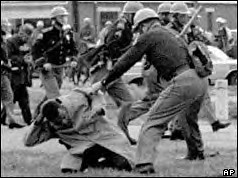
On March 7, 1965, Lewis, then one of the leaders of the Civil Rights Movement along with Martin Luther King, Jr., took his place at the head of the line for the march to the Montgomery Courthouse. These pictures tell the tale:
http://www.howard.edu/library/Reference/Guides/Lewis/BigSixFiles/0307march.gif (The man on the right is John Lewis, leading the march from Selma to Montgomery.)
http://farm1.static.flickr.com/54/189772532_cc8c41165a.jpg?v=0 (This is Lewis later that same day being beaten by cop for nothing more than walking peacefully to Montgomery.)
Lewis, walking out peacefully in support of a cause, carrying no weapon and perpetrating no act of violence toward anyone, was beaten on that day by police, along with many others, in an event that became one of the significant turning points of the Civil Rights movement. Lewis knows, if anyone does, the catastrophic effect of loosed hatred. If anyone has a right to denounce McCain’s tactics, it is Congressman John Lewis.
I have read responses to Lewis and McCain that seek to exonerate McCain and Palin from the potential consequences of their choices. The argument sometimes offers overtly the idea that although McCain and Palin are “to some degree” stirring up hate, they are nowhere near as bad as George Wallace. If it doesn’t matter what one does so long as no actual violence results, then it is true that (so far) McCain is not as bad as George Wallace. The logical conclusion of that line of reasoning, however, is that if the McCain Palin hate-talk express does, one day, lead to violence, then they will, indeed, be as bad as George Wallace. None of the defenders I have read, so far, have been willing to extend their line of reasoning to that logical conclusion, however, and so we have no idea whether, in that event, these defenders would turn to repudiators. If the defense depends on the idea that no actual bad can possibly come of hate speech, then it is no defense at all. Blissful ignorance in the form of pretense that what is today will always be seems to be the basis of the claim. I would suggest, however, that the standard of “no actual violence was done” is too low an ethical standard for any human being, let alone a President. I don’t think that anyone can take the position that it is morally acceptable to engage in dangerous behavior so long as we agree to assume blithely that no actual danger will manifest. I think that we should hold each other to a higher standard, and that we must agree that someone who plays with fire, proclaiming all the while that it could not possibly get out of control, and then is astonished and dismayed when the forest burns down, is not significantly more moral than the person who set about deliberately with flame throwers and gloated over the destruction of every tree.
Others who would defend McCain and Palin suggest that the candidates are not responsible for the behavior of those who attend their rallies. Charles Krauthammer reduces the incessant Palin incitement to hatred to “A couple of agitated yahoos in a rally of thousands [who] yell something offensive and incendiary,” for which, he adamantly proclaims, Palin and McCain cannot be held responsible. This argument, however, depends on the assumption that the actual words Palin in particular has been using are lily-white, hate-free, innuendo-free, harmless speech, and as such, could not possibly be perceived by any reasonable person as ugly, hateful, encouragement of anyone’s expression of bigotry. Just the use of the phrase “pallin’ around with terrorists” makes a mockery of that assumption. The use of the phrase “pallin’ around” is a particularly perfidious distortion. “Pallin’ around” has several insidious connotations: it suggests, for one thing, that Obama and some terrorists have no gainful employment and spend their time hangin’ out on street corners doin' nothing of any particular value. The use of the plural multiplies one William Ayers into a pack (or worse), and the present tense suggests that all this worrisome hangin' about is happenin' right now—in the middle of the campaign. The only reason for constructing the accusation in those terms is to frighten people, to make them worry that somehow the Obama campaign for the Presidency is really some sort of cover-up for terrorist activity, and to remind people that Obama’s middle name is Hussein—one of those Muslim names. In short: There is no way to argue that “pallin around” is an accurate description of a business association long past, and so Palin’s use of “pallin’ around with terrorists” as an accusation against Barack Obama can only be interpreted as deliberate incitement of those yahoos Krauthammer wishes to blame; Krauthammer’s claim, therefore, that McCain and Palin are innocent of all wrong-doing is foolish on its face.
McCain’s own response to Lewis took a slightly different tack. He he not only declared himself deeply hurt by Lewis’ comments, but he also demanded that Obama repudiate Lewis and denounce his “…very unfair and totally inappropriate” comments. McCain, furthermore, claimed, during last Wednesday’s debate, that in his turn he [McCain] has denounced all inappropriate remarks that had been made by any Republican anywhere:
“And, Senator Obama, you didn't repudiate those remarks. Every time there's been
an out-of-bounds remark made by a Republican, no matter where they are, I have
repudiated them. I hope that Senator Obama will repudiate those remarks that
were made by Congressman John Lewis, very unfair and totally inappropriate.”
Both the demand and the claim were, frankly, astounding, and, to my mind, deeply and disturbingly revealing of McCain’s mind and character.
There are two flat-out lies in McCain’s remarks: neither the claim that Obama did not denounce Lewis nor the claim that McCain has consistently repudiated all hate speech is true. The morning after Lewis published his statement, Obama did, in fact, release a reaction to Lewis that bluntly repudiates that implied equation of McCain with Wallace, but with a sole exception, that anyone knows about, McCain has emphatically not repudiated any of the hate speech stirred up by the sinister intimations Palin has delivered—nor has he shown any sign of trying—or wanting—to stop her eliciting the reactions she clearly intends to elicit. (Unless, furthermore, he is willing to repudiate his own campaign ads, such as this one, McCain’s claim will not become true in the future, either.)
McCain did, one day last week, take the microphone back from a woman who was proclaiming, during a town-hall format meeting, that she was scared of Obama because she had been reading about him, and he is “an Arab.” McCain did repudiate that, saying, with an irony he did not recognize, “No. He’s a decent family man, citizen….” The repudiation is double-edged, because it implies that had he actually been an Arab, there might have been something wrong, in addition to which, apparently, no Arab is a decent family man, but inadvertent bigotry aside, that is the only incident that has been reported in the press, so far as I have been able to find, to indicate that McCain’s claim that “…I have repudiated every time someone's been out of line, whether they've been part of my campaign or not, and I will continue to do that” is even remotely accurate. I am more astonished by the fact that McCain apparently thinks that even in a culture in which information is immediately and widely available 24 hours a day he can make such a blatantly false statement and have it be believed than I am by the lie itself. I don’t know whether this is sheer chutzpah or sheer ignorance, but neither characteristic seems desirable in a President. The only other possibility I can think of is self-delusion, and that, too—even more than the other possibilities—would disqualify McCain from the role he seeks.
These troubling traits were demonstrated in a variety of other ways during the exchange in the debate over Lewis’ remarks. The implication that Obama is the one, of the two of them, who has truly violated decency by refusing to repudiate Lewis demonstrates either ignorance or willful disregard of the fact that Obama had already done what McCain was so petulantly demanding. Indeed, on Monday morning, immediately after the publication of Lewis’ comments, Obama issued a statement in which he did specifically say that Lewis’ comparison went too far. The official statement read, in part: “Senator Obama does not believe that John McCain or his policy [of] criticism is in any way comparable to George Wallace or his segregationist policies.” It seems unlikely that McCain truly did not know this, so it seems that this must have been a deliberate lie. If, in fact, McCain did not take the trouble to make himself aware of the Obama campaign response to John Lewis, then he is as ill-informed and as disinterested in informing himself as Bush has proven himself to be, and we have spent eight years learning the hard way what devastation results when we have a President who is either content with his own ignorance or arrogant enough to suppose that if he doesn’t know it, it either wasn’t important or it didn’t happen.
McCain additionally exhibited an apparently willful refusal to recognize any difference between a citizen completely unaffiliated with the Obama ticket expressing his unsolicited personal opinion about what constitutes reprehensible and dangerous human behavior and a member of the McCain ticket repeatedly and overtly eliciting hate speech as a tactic for trying to gain votes. I am no more convinced that willful blindness or stubborn refusal to face reality is a positive quality in a President than I am that brazenness or ignorance is.
The pained and accusatory demand that Obama issue a repudiation of Lewis’ remarks additionally revealed that McCain suffers from an all-too-human proclivity both to see himself as the injured party and to exonerate himself from wrong-doing. His hurt outrage suggested to me that McCain’s sole concern was with the thwarting of his personal desire to be President, and, consequentially, he was oblivious to and uninterested in the idea that there might be actions which are truly not acceptable as a means of pursuing that desire. He proclaimed himself “proud” of everyone who comes to his rallies, and declared that he can’t be responsible for some “fringe peoples” who might be expected to turn up in any large crowd. This, too, is the Krauthammer argument, and it is as willfully blind coming from McCain as it is coming from Krauthammer. At the very least, it is naïve to try to take a position that Palin hasn’t been saying anything the least bit underhanded, untruthful, or dangerous, that she is completely ignorant of the effect of her words, and that neither she nor McCain himself are in any degree responsible for encouraging bigotry. While the desire to be the wounded party rather than the wounding one might be commonly human, it is not what I expect from a President. Reality matters. A commitment to personal responsibility matters.
Finally, McCain’s misrepresentation of Lewis’ remarks demonstrate either a lack of understanding (not likely) or one more deliberate and desperate attempt to find a way to associate Obama with someone undesirable. McCain described Lewis’ remarks this way:
“…a man I admire and respect -- I've written about him -- Congressman John
Lewis, an American hero, made allegations that Sarah Palin and I were somehow
associated with the worst chapter in American history, segregation, deaths of
children in church bombings, George Wallace. That, to me, was so hurtful.”
The suggestion is that Lewis made an untruthful and heinous claim that McCain took active part in Wallace’s depravity, and that Obama, by associating himself with anyone who would make such a patently false claim is further disgraced. Lewis, however, did no such thing. In the first place, the only allegation he made is the undeniable one that McCain and Palin have been indulging in hate speech. The invocation of George Wallace was as an example, and a potential comparison; it was not by any stretch of the imagination an attempt to suggest that McCain and/or Palin was actually present during Wallace’s rallies or party to any of his activities. Sarah Palin, in direct contrast, has specifically implied that Obama himself was part of Ayers’ violent anti-government activities. Mary Mitchell, writing in the Chicago Sun-Times, says:
“At another point during her rant, Palin cited a New York Times article that
described Ayers as ‘part of a group that quote “launched a campaign of bombings
that would target the Pentagon and our U.S. Capitol,”’ she rattled off as if she
was talking about 9/11.”
This is a clear attempt to suggest that Obama, in having been in some minor way associated with Ayers, is not only directly linked to the bombings that William Ayers perpetrated when Obama was eight years old, but that, worse, Ayers, and by the false association, Obama, was somehow involved with al-Qaeda.
The absolutely incredible—and I mean that in the sense of not believable—irony inherent in McCain’s accusation is that in accusing Obama of doing what McCain is actually doing, McCain makes clear that to employ such a tactic is absolutely beyond the pale and so should be immediately halted. It would be easy enough to simply ascribe the irony to McCain’s general pattern of falsehood and denial, but I find myself wondering whether it is not, in fact, the result of something even worse: an actual failure to see the parallel. If McCain is truly unsubtle or insensitive enough to recognize irony, if he is incapable of seeing himself doing what he accuses others of doing, then he is incapable of self-reflection, and I can think of nothing more dangerous in a President. I have long thought that George Bush was completely impervious to any criticism—least of all from his own assessment of his own decisions and behavior—and that lack of reflection has been disastrous. If McCain is cut from the same cloth, then he lacks another essential qualification for the Presidency.
I have argued in this space before for the need to use language in a way that promotes truth, rather than trying to fabricate it. McCain’s representation of Lewis’ statement is a further example of fabrication. Had John Lewis made excessive and slanderous remarks to the effect that John McCain has now done as much damage to Civil Rights as George Wallace once did, perhaps we might need to question Lewis’ rationality and write him off as being the one who is out of line. But the fact is that Lewis’ was right. His statement does not, despite Obama’s careful denunciation, draw a direct comparison between John McCain and George Wallace; instead, it offers up Wallace as the extreme example of the possible end result of beginning where Palin and McCain have begun. Outraged McCain supporters may exclaim that drawing such a fine differentiation amounts to mere picking of the nits, but I suggest that it does not: Lewis’ statement is, instead, what I would wish for all literate people to be able to produce: a careful and precise delineation of the relationship between facts and patterns. Lewis does not suggest that McCain is right now a reprehensible George Wallace reincarnate; instead, he does suggest, truthfully, that when public officials are willing to tolerate—and, more directly, engage in—unleashing the dogs of war, they cannot expect to contain the damage within whatever bounds they consider acceptable, that because they cannot control the outcome, and because the potential outcome is catastrophic, they should not provide the cause.
This is a warning that all of us, McCain and Palin most especially, need to hear. McCain, however, seems to have put all his chips on the idea that he can implement the Goldilocks version of hate speech: he seems to think that he can create just enough havoc. McCain, I am sure, would be delighted with just enough hatred of Barack Obama to cause just enough switching of votes to ensure a McCain win. I am sure that he would be horrified to discover one day, in the worst-case scenario, that his effort at character assassination had led to an actual assassination, but this limited-nuclear-war approach to fanning the fires of rage is naïve and dangerous. It’s hard for me to imagine that McCain does not understand the dangers of inciting to riot, so perhaps he simply cannot admit, even to himself, that he has sunk so low as Lewis’ portrait of him so rightfully suggests. John McCain is not George Wallace in the sense that, though the dogs are out, they have not yet run down and devoured the prey. If George Wallace was content—or even thrilled—to have a cataclysm result from his incitement, then I am sure that John McCain is not that George Wallace either. But John McCain is George Wallace to the extent that he is actively engaged in unleashing monsters with apparently willful disregard for the havoc that may ensue.
A proclivity for telling falsehoods, blind ignorance, willful ignorance, a lack of sensitivity to the meaning of words, a lack of awareness of the power of modern information systems to deliver actual facts, an inability to self-reflect, a lack of ability to understand that blatant untruths make the speaker of those untruths look petty, arrogant, and stupid, and a complete unwillingness to live by any real standard of honest discourse are the traits that McCain exhibited in his reaction to John Lewis; dishonesty, willingness to trade on bigotry and hatred, and small-minded determination to win at all costs are the traits that he—and his running mate—have exhibited over the past few weeks in their descent into attack campaigning. In both the debate and in the new campaign strategy, McCain and Palin have demonstrated their allegiance to a moral code that exonerates malefactors from the consequences of their choices on the grounds that so long as they do not actively swing the sword, they are not responsible for the head it chops off.
The first amendment does protect McCain and Palin’s right to say what they want about Obama, but they are, as we all are, nevertheless responsible for the consequences of what they say. It is to be hoped that the least of those consequences will be continued public denunciation of their resorting to hate speech. McCain and Palin have certainly earned the just condemnation of their words and actions by John Lewis and all others who believe in the fundamental rightness—and more the necessity—of choosing not to stoke the fires of ignorance, anger, fear, and frustration, all of which lead far too easily to violence against anyone offered up as a target for bile. As I wrote once before, I cannot say that the developments of the past two weeks have made me any less likely to vote for McCain, as I would not under any circumstance have voted for anyone with so similar an outlook to George Bush, but to my mind the decision to wield hate speech as a weapon in his campaign, as with the decision to name Sarah Palin as his running mate at all, disqualifies John McCain for the Presidency. We cannot have as the leader of this nation someone willing to use hatred as a tool for his own ambition. In “unleashing” Sarah Palin, in choosing not to abandon the tactic, despite overwhelming public disapproval, in refusing to accept the picture of himself painted by Edward Lewis as an indicator of how far he [McCain] has strayed from basic human decency, and in choosing, instead, to attempt to cast the denunciators of hate speech as the true villains, McCain has chosen the lowest of the low roads.
I suppose that I ought to be glad to see the McCain campaign implode this way; I ought to be happy to find increased hope for an Obama victory in the fact that the outrageous tactics are seen as outrageous by many thousands—millions, even—of others, and not simply by me. (My husband has just informed me—via text message, as I am on a train out of reach of Internet—that Colin Powell has today endorsed Barack Obama. I wonder—pure speculation on my part—whether this is part of the price McCain is paying for his employment of hate speech.) I should perhaps be gratified that the choice to pursue the hate speech tactic has alienated more voters than it has won over, but in truth I cannot feel happy even if this proves to be the decision that seals McCain’s fate and assures Obama his place in the White House come January. I would rather have had the election fought and won fair and square than have to face the distressing fact that there is still enough fear and hatred in this country to make a hate campaign seem like a viable tactic, I would rather not be living with the terrifying specter of renewed racial violence in this country forty years after the Civil Rights Act was passed, and I would rather not have seen the depth of ugliness of which both McCain and Palin have demonstrated themselves to be capable. I would rather think better of people.
Addendum: Here is video of McCain this morning on Fox news traveling the same ground of Obama’s secret and unrevealed ties to Ayers as well as his purported refusal to repudiate Lewis’ remarks over again. The clip includes the audio of one of the RoboCalls that McCain is using; it is particularly repugnant and embodies all the deception that I have written about here. McCain is adamant that he has done nothing wrong, and he gets agitated trying to convince the interviewer of this fact. Delusion or lies? I’m beginning to think that it’s the former—that McCain has really lost his way so far as to believe his own ugly press. If so, that is a very sad place for someone who has done many great things for his country to end up. Delusion or lies—either way, the continuing insistence on the legitimacy of patently false allegations is deeply unpalatable and disturbing. In a wonderful counter-balance: I have now had the opportunity to watch Colin Powell’s endorsement on Meet the Press this morning, and it is brilliant, balanced, sane. I have embedded it above; I highly recommend you watch it if you haven’t.
UPDATE: Tuesday--I have corrected Congressman Lewis' title and added in a number of hyperlinks to my sources that I neglected to add when I got off the train on Sunday.
Question: There are various technological tools available now – new cell
phone technology, the Internet, etc. How can women make the best use of these
different technologies? How do we ensure that women who have access to
technology such as cell phones or the Internet or women who become members of
iKNOW Politics share the knowledge they have with other women?
Answer:
Women must get together and share their knowledge, whether it’s over work, or
being with children, or just creating small groups to share various kinds of
information and mutual support. In some villages, for instance, the woman who
has access to the only cell phone around actually rents it out to people. The
phone then becomes a new power tool. It is critical for this woman to share
physical access to her cell phone, teach someone else to use it, or take
information from it and do what women do very naturally -- gather other women
together to talk and share information.
As American women, however, we
need to be careful not to superimpose our image of how to do things on women
from other countries. But, information must be shared. A woman who gets power –
either because she has a particular position in society or government or because
she has a cell phone – can’t become a queen bee! Women must help other women. I
have this saying that I use quite frequently, which is that there is a special
place in hell for women who don’t help each other. A woman with power must
understand that, in actuality, her role is to help others. For a woman who wants
to be at the center of power, she must understand that her power is actually
maximized by encouraging more women to participate in the system.
Asked, this week, to contribute my two cents worth to an effort entitled "Women Against Sarah Palin," I found myself oddly reluctant to do so, though among the people I know (male or female), I am certainly among the most appalled by the circus that has erupted following the announcement of Ms. Palin as John McCain's choice for VP. After a few days' mulling, I decided that I don't like the implications of proclaiming myself "against Sarah Palin." Although it is true that I disagree absolutely with every Sarah Palin ideal, value, principle, or policy of which I have so far learned, I suspect that to be against Sarah Palin might be to play right into the hands of those who conceived the political gambit of choosing her for the McCain ticket.
I do, however, agree whole-heartedly with those who solicited my input that if some part of the McCain strategy was the hope that choosing a woman would draw the votes of women who wanted to see Hillary Clinton as the Obama running mate, then it’s time for those women to speak up and disabuse Senator McCain and his cohorts of the notion.
I am appalled by the nomination of Sarah Palin.
I am appalled for all the ordinary reasons that other liberal thinkers are appalled:
*I am against the idea that books can and should be removed from library shelves because some people don’t like them.
*I am against the idea that abortion is wrong in every circumstance, including rape and incest.
*I am against the idea that creationism should be taught in the science classroom alongside evolution.
*I am against the idea that young people should not be educated about the dangers of profligate sexual activity.
*I am against the idea that gay marriage should be banned.
*I am against the idea that mankind is not contributing to global warming.
*I am against the idea that offshore drilling or drilling in the country’s National Wildlife Refuges will constitute a long-term solution to the world’s energy problem and that, therefore, the environmental cost is worth the gain in oil.
*I am against the idea that the war in Iraq is an act of God’s will, a justified and holy action against those who attacked the United States on 9/11.
*I am against the idea that we can, and therefore should, win the war in Iraq.
*I am against the idea that spending federal money on a project other than the “Bridge to Nowhere” demonstrates standing up to Congress on the issue of earmarks.
*I am against the idea that religion is an appropriate guiding force for governmental policy.
*I am against the idea that being the titular head of the Alaska National Guard gives one experience in military or foreign policy, particularly when the number of orders one has issued to the National Guard to date is zero.
*I am against the idea that the fact that Alaska is near Russia qualifies one as having foreign policy experience.
*I am against the idea that aerial hunting is an activity that ought to be funded by the state—or is an activity that ought to be undertaken at all.
*I am against the idea that Polar Bears should not be classified as endangered because it is more important to keep developing oil sources.
If the choice of Ms. Palin was aimed at people like me, who preferred Senator Clinton to Senator Obama as a potential presidential candidate, then let me go on record as saying that I am not converted. I do not think that all women are Hillary Clinton, or that any woman is equally qualified to serve in the highest office of government as any other, just because she IS a woman, or that views on issues of personal freedom, environment, or national security are less relevant than gender in choosing a national executive. I do not, in short, think that any woman will do, any more than I think any man will do. For the record: I am one woman whom it will be impossible for Sarah Palin to charm into supporting John McCain.
That said, I am further compelled to say that Ms. Palin’s attitudes themselves, though disturbing in the fact that alone and together they offer a vision of the world that seems short-sighted and contrary to the kind of vision of personal freedom that a vigorous implementation of the spirit of the Constitution would allow us to achieve, as well as representing a world view that, institutionalized, would effect a move away from progress in basic human rights, seem to me to be less disturbing in and of themselves than the larger implications of the fact that McCain chose Palin at all, or of the profoundly disturbing tenor of the political discourse resulting from that choice.
I don’t really think that the primary motivation in selecting Sarah Palin as a running mate was the hope of luring disaffected Hillary fans to the McCain effort. That was my immediate reaction when I first heard of the choice, but that was before I knew anything at all about Governor Palin. Having had a few weeks to learn, I am now convinced that anyone who thought that Governor Palin could win over even one Hillary voter would have to be seriously deluded. I think now that the motivation for choosing Sarah Palin was a great deal less obvious and a great deal more subversive. What Sarah Palin brings to the McCain campaign is not the power to lure Hillary Clinton voters, but rather the power to derail serious political discourse and to drag the whole campaign down to the level of mud-slinging frenzy.
Sarah Palin functions as a lightning rod precisely because of her extremist, contradictory, even arguably hypocritical statements. She angers liberal thinkers so deeply that the temptation to attend to her is very nearly irresistible. I recognize the powerful pull of the completely outrageous; I recognize the overwhelming desire to respond to the fear that this woman and her policies could actually end up running this country. I admit it: I’ve read more newspaper articles and listened to more news stories about Sarah Palin than I did about any of the other candidates before this. And I think this is precisely what the McCain campaign was counting on. The more we are outraged by Sarah Palin, the more time and energy and inches of newsprint we expend on showing how outrageous she is, the safer McCain is from scrutiny. Every day that goes by on which we don’t put McCain onstage answering questions front and center is another day that people don’t see how old he looks, don't consider whether he is physically up to at least four years of a gruelling job, don’t attend to how mean-spirited his ads and speeches have become, don’t attend to how much his platform has morphed from what it once was. Every day that we expend on Palin is another day that McCain doesn't have to sell himself as worthy and capable of doing the job for which Palin is NOT in line.
While people from all areas of the political spectrum busy themselves in screaming fights over whether the press is being “too mean” to Sarah Palin or whether anyone would have asked “that question” to a male candidate, or how unfair it is for anyone to drag the Palin children into the political fray, or whether the democratic candidate is too “elitist,” the real issues are off the table. Every time Barack Obama and his campaign succumb to the invitation to engage on the issue of Sarah Palin herself, they open themselves to character attacks, and they sacrifice another opportunity to debate their own issues on their own terms. Sarah Palin is a star, and we have all turned ourselves into the fawning paparazzi that trails around stardom. In a 2005 episode of The West Wing entitled “Freedonia,” Donna Moss drew fire to the John Hoynes campaign by allowing herself to be suckered into arguing with a man in a chicken suit. Far from backfiring, I think that the Sarah Palin pick has accomplished exactly what it was intended to accomplish. These days, thanks to the injection of Sarah Palin into the political mix, we are all become Donna Moss, humiliating ourselves by arguing with a chicken. A hated war, an economy on a potentially catastrophic downswing, impending environmental disaster: all are forgotten or, at the very least, demoted to irrelevancies when it comes to choosing a President.
I am against the degradation of the political process into squabbling over hurt feelings. Even more than that, I am against the deeper insult to women—and to voters in general—implied by this McCain decision. The selection of a woman because she can be counted on to lead a tremendous national charge into the trivial and the irrelevant is the exact opposite of taking a woman seriously as a political force. Not so very long ago, Hillary Clinton was pilloried in the press for crying in public because crying was too womanly, and in the tenor of that day, any woman who expected to be allowed to act like a woman was considered far too weak to run a country. Now the song has changed completely, and anyone who asks the current woman to answer a tough question is accused of anti-feminist motives. Even Charles Gibson, the only person to date who has been able to deal with Governor Palin solely in the impersonal context of political issues, was immediately accused of being unfair for pursuing answers to hard questions. While the expectation that Mrs. Clinton should act like a man might be less than comforting as a sign of the real acceptance of a woman in a national leadership position, the incessant insistence that Mrs. Palin, because she is a woman, should not be expected to have to demonstrate the same knowledge, strength of character, or courage as a male candidate would have to demonstrate is less palatable still. If my read of the McCain strategy is right, Governor Palin is not offered to us as a serious political force, but rather as a creature on display—the sideshow at the circus. The selection of Sarah Palin thus constitutes no audacious storming of the male bastion of American politics; rather it demonstrates a deep contempt for women as equal participants in affairs of state.
This contempt appears to me to extend beyond Governor Palin to the electorate. The whole Palin strategy depends on the expectation that voters will allow themselves to be lured away from the substantive by a few crumbs of novelty, surprise, and the excitement of outrageous extremism. So far, many of us have played our assigned roles uncomplainingly, and this is what I find the most distressing aspect of the whole brouhaha. I want to think that the largest segment of the American population consists of people who will choose reason over emotion when it comes to making important, long-term decisions, care about real issues that make the difference between whether people live or die more than they care about whether a candidate’s five weekly girls’-night-out friends would vote for her, and cannot be fooled into voting yet again for someone blatantly being promoted as a small-town buddy we would love to have a beer with.
My greatest sorrow arising out of the Sarah Palin maelstrom is seeing the American public tied up in knots over what doesn’t matter, because such a vision makes a mockery of my desire for a wise, educated, and caring electorate committed to the greater good. The thing I am most against in the whole sorry mess is the possibility that people will forget that the two most recent elections, each based on the very policies McCain and Palin are now preaching, led to eight disastrous years which we cannot afford to repeat, that they will once again succumb to the allure of runaway pandering to weaknesses, fears, knee-jerk reactions, and short-term desires, and that they will once again elect someone who holds in contempt the needs of the people they are sworn to serve. I may be against Sarah Palin’s views, the degradation of the female as a political force, and the McCain campaign’s apparent confidence in its ability to manipulate an easily-manipulated public, but I am most of all against the general public’s living down to McCain’s expectation.
I cannot say that the choice of Governor Palin for VP has made me less likely to vote for Senator McCain, for there was no possibility that I would have voted for Senator McCain to begin with; what I can say is that the choice of Governor Palin frightens me. It suggests to me that Senator McCain is not as straightforward and honest as I had thought he was. It suggests to me that Senator McCain is less, not more, of a maverick than I had thought he was. It suggests to me that Senator McCain is far more like George W. Bush than I had thought he was, and that he is, therefore, much more dangerous as a potential president than I had thought he was, because the choice of Sarah Palin reflects an attitude toward political decision-making that raises the spectre of another Machiavellian administration which believes in winning at all costs, and so glories in manipulating public opinion. I may not like the implications of being said to be “against Sarah Palin,” but I am profoundly against the implementation of another administration which expends its time and energy and our national resources on amassing power to itself, rather than on generating real solutions to real problems.
Internet Sources (all accessed 9/13/08):
http://www.libraryjournal.com/blog/1010000101/post/1110032711.html
http://www.adn.com/sarahpalin/story/511471.html
http://firstread.msnbc.msn.com/archive/2008/09/01/1320417.aspx
http://www.reuters.com/article/companyNewsAndPR/idUSN2944336720080829
http://ap.google.com/article/ALeqM5jNulPSqaP1eyysv8ENJWhk0ZSrPgD92VJPL00
http://www.adn.com/sarahpalin/story/511471.html
(http://news.aol.com/political-machine/2008/09/02/sarah-palin-iraq-war-gods-plan/)
http://thinkprogress.org/2008/08/29/doocy-palin-russia/
http://www.thelangreport.com/religion-or-lack-of/sarah-palin-wants-creationism-taught-in-school/
http://www.huffingtonpost.com/2008/09/11/sarah-palin-supported-aer_n_125718.html
http://abcnews.go.com/Politics/Vote2008/Story?id=5782924&page=1
http://www.theglobeandmail.com/servlet/story/RTGAM.20080912.wcampibbitson12/BNStory/usElection2008/home
http://www.tv.com/the-west-wing/freedonia/episode/383242/summary.html


 Posts
All Comments
Posts
All Comments