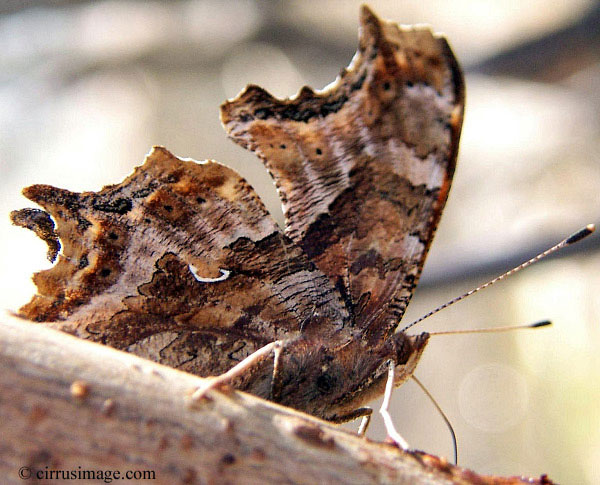
"His lacklustre attorney-general Alberto Gonzales, who was forced to resign in disgrace, was only the most visible of an army of over-promoted, ideologically vetted homunculi."

from "The Frat Boy Ships Out" The Economist 1/15/09
Showing posts with label butterflies. Show all posts

Sunday, July 4, 2010

The Day of the Sachem


The real-world lunacy seems to have overtaken me, and caused me to abandon this Lunacy for some months, and it is with the hope of keeping a rather more regular schedule over the next year that I once again take keyboard in hand to post to my not-quite-defunct blog.

Yesterday was our annual butterfly count--Maidens #16. We were expecting a calamity, as it has been inordinately hot--hottest Spring on record, hottest June on record, and three days in five last week were record-setters. Numerous days in a row over 100. Everything is bone dry, and we hadn't seen a butterfly on the wing in weeks. Although the forecast for yesterday was pretty close to ideal (high of 85--turned out to be 88 in actuality), sunny, light breeze, we were nevertheless making dire predictions of being home for lunch in the total absence of anything--Lepidoptera or otherwise--flying.


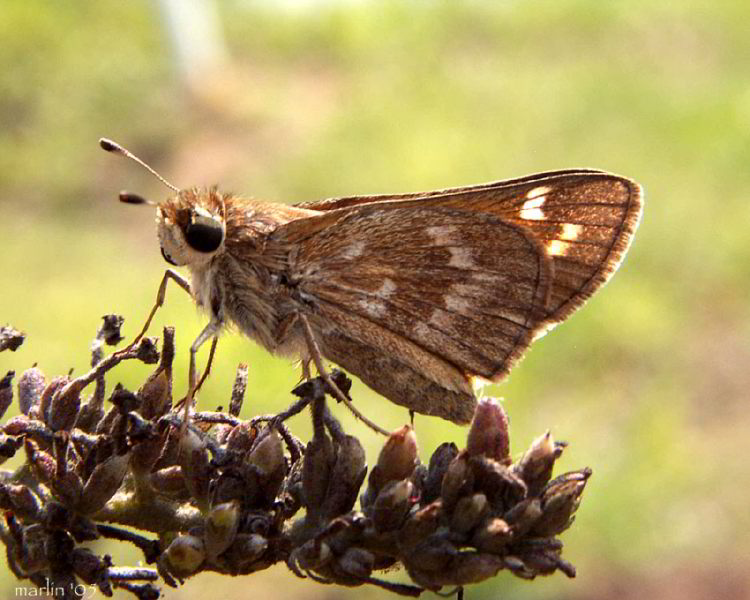
Hah. Turned out to be one of our biggest counts ever, in terms of individual butterflies, all due to an explosion of Sachem (Atalopedes campestris, for the Latin purists among you): 563 of them. This was not merely big bug of the day, it was big bug of all time, at least so far as the Maidens count goes.

Just for the record:  previous high Sachem on our count was 351, in 2008, which was also the previous high for any butterfly on our count.  That tally was followed closely by 337 Tiger Swallowtails in 2000 (the year we had 57 species and 1292 individuals).  The next, but relatively distant, best was 276 Pearl Crescents in 2002.  Impressive as those numbers might seem, we have never approached 500 of one species before.  We have had fewer than 563 total individuals on eight counts--half of all those we have ever held.  The 563 Sachems yesterday also constituted 57% of the whole count;  the previously mentioned Sachems, Tiger Swallowtails, and Pearl Crescents constitued only 36%, 26%, and 36% of their respective counts.  (For those of you dying for the math:  563 individuals yesterday constituted a 60% increase over the previous high in terms of percentage of total count.) That should give you some idea of yesterday's experience--Sachems, Sachems everywhere, and not a prayer of being able to count them all.  (Reminded me of the year I was doing the Tarrant County, Texas, count with David, and we two counted over 1200 Dainty Sulphurs--if I remember rightly, there were numerous other counting parties, and the Tarrant County count turned in something over 3000 Dainty Sulphurs on the day.  Wild.)

Plenty of goofy stuff happened along the way to our 563 Sachems: 

We left about an hour later than usual, as the temperatures were so unseasonally low that we did not figure on seeing anything flying.  It was 68̊ when we set out--even that was probably too cool, but by the time we got going at Irwin, it was warming up, though the moon was still out!
Last year, you may remember, Irwin was in corn and we got damn-all.  This year, the fields were fallow, and there was clover and milkweed trying to grow in the cement-like ground.  This did generate a few things, and we got a respectable tally, including four Monarchs here.

At the next stop, I encountered the real big bug of the day--a critter numbering in the thousands :  waterbugs on the James River.  I took a hike down to the river at the spot where last year I infamously encountered the Butterfly Count Photo Opportunity of the Month:  a goat in a tree (click here if you need to refresh your memory), only to discover that the goats are now gone--as is the fence and any sign that there were ever goats there.  Perhaps I made them up.  Along with the goats, evidently, went every butterfly that I used to find puddling in the mud there at the edge of the river.  I did, however, encounter this quite charming little toad:


He did not appear to find me quite so charming--he expended a good deal of energy hopping away.


Having lost sight of the frog, I turned my attention to the river which, though running very low, was quite bucolic yesterday, as you can see above.  A closer look, however, reveals the true big bug of the day:  Water beetles.


Look very closely.  Those are not shadows, those are the beetles.  THOUSANDS of them.  They were swimming about in rapidly shifting swarms, and in so doing, they were changing the whole look of the river every few seconds.  Pretty cool, actually.

This is a close-up look--each beetle is maybe 1/4" long; think how many it takes to make the river swirl in flowing shadow.

A few minutes later, I added scampering fawn to the tally of wildlife.  This photo doesn't do it justice, and it's too bad I didn't have a video camera, because this little fellow vaulted across the landscape in front of me in a long series of  huge leaping bounds.  I had a skipper in the net at the time, trying to finagle it into a plastic vial for a definitive identification (Sachem, of course--every single time I netted or stalked a skipper yesterday thinking it might be something new, it turned out to be Sachem), and with one hand thus engaged, I didn't have time, or manual dexterity enough, for finesse.  I just pointed the camera and started clicking, without pausing to worry about focus or zoom.  Still, you get a little flavor of the fellow's haste.  I wonder what set him off?  Broke his mother's best dishes?


Elsewhere in the circle we also saw a female adult and a male with antlers--the whole family separated by circumstance...and a few high speed roads.

At the Westview boat landing, a friendly fellow shoving off for a day kayaking with friends, having ascertained what we were up to, advised us to pee on a rock if we wanted to attract butterflies:  "They like to take the minerals out of the urine," he suggested.  This was actually fairly reasonable advice, though we did not feel compelled to act upon it, but  it was rendered suspect when the same guy also informed me that what he learned about butterflies during a week-long float trip last week was that they know where the best campsites are.  "Just look for the places where there are lots of butterflies--those are the best places to camp."  Make of it what you will.  His remarks did, however, call to mind the time that a snake way up in the tree peed on our car.  This is a story we recount every year and we still look up every time we park the car under the trees at the boat landing, despite the fact that this must have been 15 years ago, as I believe it was my Nissan Sentra that was so annointed.  Still, the event was memorable, and perhaps most memorable for for the quantity of liquid extruded.  Who'd have thought the old reptile had so much pee in him....Perhaps, in light of my new knowledge, I might conjecture that he was trying to attract butterflies. 

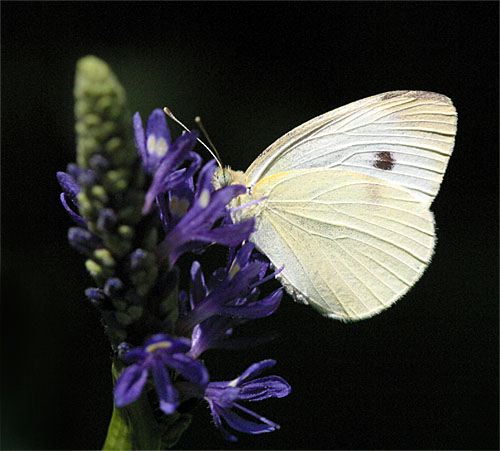
No adventures with pee occurred yesterday, however, and we moved on to our next stop:  Formerly called Lyddan, now called simply Pemberton, as Chris Lyddan sold the land about five or six years ago, and we finally managed to track down the new owner, Orane Holstein, last year.  (Why we call Lyddan Pemberton now, and not Holstein, I have no idea.  The naming of things is just one of the mysteries of the universe!)  Mr. Holstein has kindly continued the tradition of letting us count on his property.  This is a particular boon, because his property, on a sandy, rocky site that used to be some sort of railroad siding, is the only place in the count circle where a particular kind of little thistle grows.  (See photo below with Cabbage White):


This thistle is extremely attractive to butterflies, and in years when it prospers, we tend to rack up the species and the numbers here.  A few years ago, the last year Lyddan had it, the whole place was razed, and it has taken some time for the thistle to return, but it was there yesterday in full flower and growing in profusion all over the lot, home to 314 of our 563 Sachems.  Totally amazing sight--take a step, a cloud of Sachems swirls around you.  Good luck with the counting!  It was easier to count the Silvery Checkerspots (12):


Following the frenzy of frenetic activity necessitated by the flurry of flourishing skippers (my apologies for the failed alliteration, there!), the Cartersville boat landing, normally a pretty productive site, was a major letdown, largely because it was positively swarming with people--many more than we have ever seen there before.  Instead of finding the 50-100 puddling Eastern Tailed Blues I was expecting (last year we got the Harvester thrown in for good luck), I instead had this conversation with one of the numerous beer-drinking, shirtless specimens who was camping on the site:

Beer-Drinking Shirtless Guy [BDSG]: "Hey, Ma'am!  Can I ask you a question?"

Me [Me]: "Sure."

BDSG:  "I heard this story about butterflies.  These orange ones.  These Monarchs.   I heard that they fly all the way to South America.  Is that true?"

Me:  "Yes, pretty much.  They migrate to Mexico to overwinter."

BDSG: "Will this oil spill be a problem for them?"

Me:  "No, I shouldn't think so.  They overwinter in the mountains--the logging of the rainforests is a much bigger problem." 
Might as well try for some ecological education if you get the chance, right?  A futile effort, I fear, as you will soon see.

BDSG:  "Them Monarchs.  They're not the big orange butterflies I see, right?  They're the little ones."

Me:  "No, Monarchs are actually quite large."

BDSG:  "Then there's those big yellow ones.  What are those?"

Me:  "Tiger Swallowtails."

BDSG:  "Yeah, those orange ones.  They're as big as those big yellow ones.  But it's not those, right?  It's those medium sized ones."

Me:  "No, the Monarch is just about as big as the Tiger Swallowtail."

BDSG:  "Does the yellow one go to Mexico?"

Me:  "No, only the Monarchs migrate to Mexico, so far as I know."

BDSG:  "What are those medium orange ones?  I see lots of those."

Me:  "Well, I would guess that those are Variegated Fritillaries."
Granted that this even more seat-of-the-pants species identification than we usually engage in on a count--we do at least generally SEE the creature we are trying to name!--but in this case, the identification seemed to cause BDSG some considerable consternation--more than would seem warranted, even by the wild guessing. 

BDSG:  "Fritillaries!!?!"
But after the initial shock, he managed to continue.
BDSG:  "Do they go to Mexico?"

Me:  "No, only the Monarchs."

BDSG:  "I see those Monarchs flying down by the river.  The orange ones.  They're headed south."

Me:  "It's a bit early for the migration, though; you will see many more in September and October.  They do come through the Richmond Area."

BDSG:  "Those are the little orange ones, right, not the big ones."

There was a lot more in this vein, but you get the picture.  He was very polite though, and told me thank you when we were finished.  I'm pretty sure, though, that after our conversation he thinks that Tiger Swallowtails migrate to Mexico, that Monarchs are "those little orange ones," and that Variegated Fritillaries pose some sort of danger to the further existence of mankind. 
It was our year for close encounters with the strictly local fauna.  Upon arrival at Powhatan Wildlife Management area, my adventures in counting were postponed by a very friendly, but heat-stricken hound dog who came trotting up to me begging to be petted. 


There wasn't another soul in sight--and no cars anywhere, and, as there was a large collar with a huge, easy-to-read ID tag on it, I pulled out my handy-dandy cell phone, which was, contrary to Murphy's Law, actually getting a signal, called the number, and embarked on another rather bizarre conversation, this one consisting primarily of my trying to explain to this man where I was with his dog.  It began with a woman answering the phone, and when I asked whether they were missing a dog, she didn't waste any more time with me, but hollared down the hall:  "Billy!  It's one of your dogs!"  I wondered, fleetingly, whether Billy the Dog Owner thought that the dog had actually managed to find a phone....  At any rate, Billy the Dog Owner knows the Wildlife Management Area a great deal better than I do, and he kept offering me reference points like "the Three-Lakes area" or "across from the campground" or "way out there in the back?"  As I could see only one lake, and as I never knew there WAS a campground there, and as I thought I was right near the front of the park, we were making no progress at all.  Finally I resorted to telling the man how I got there--"If you're headed east on 60...."  When I finished my recitation, Billy said that he knew exactly where I was, and would be there in 10 minutes.  I was skeptical, but in fact he was there in five--just long enough for the dog to drink about half the water from one of the jugs in the car. 

Good deed for the day over, I proceeded to find the only Question Mark and the only Common Checkered Skipper of the day.  Tim got a Red Admiral, thus ensuring that we avoided the dreaded Vanessa shutout, so it was a good stop all around.

We decided to go on to Powhatan Lakes, although we were getting tired, and, once again, we were not disappointed:  we picked up Great Spangled Fritillary, the first (and only) specimen of the day.  We have never had a count without Great Spangled Fritillary:  it was #2 Big Bug on our first two counts, and so has a special spot in Maidens count history.
This is, indeed, one of the amazing things about butterfly counting, at least in our circle:  it almost never fails that everywhere we go we get at least one butterfly we didn't get anywhere else, and that fact justifies our trudging around in that 9th hour where we are hot and tired and could easily rationalize heading home.  Yesterday, we made the heroic effort to hit Hidden Rock Park, regardless of the fact that we were hot and tired and the park would be full to overflowing with people ignoring the signs not to take their vehicles down to the picnic area and blasting loud music all over everywhere.  We figured we'd just get another 150 or so Sachems (102, in actual fact), but that was not all:  at Hidden Rock Park, at 6:15 in the evening, 9 hours after we set out, we spotted Gray Hairstreak, foiling the hairstreak shutout, and ending the count with a bang.
As it happened, then, our dire predictions for the day were dramatically, stunningly wrong.  We only got 29 species (bottom third for us), but the 984 individuals is the third highest count ever--only 3 behind #2.  Better not ask us to tell your fortune.  We are extraordinarily bad at telling the future!

Next year, maybe fewer humanoids and more lepidopteran species.
Note:  All the photographs are mine, taken 7/3/2010 on the Maidens Butterfly Count.


1. Footote:  we have to disqualify the ticks that get on Tim, otherwise we'd be counting for months.  He must be tick elixir.  He attracts so many ticks that some of them end up on me.)


Blogged with the Flock Browser

Sunday, June 28, 2009

Hot, Humid, and Harvester: Adventures in Butterfly Counting

Yesterday was our annual count for the North American Butterfly Association (NABA). If you are unfamiliar with the concept, you can learn more here, but basically, it's an adaptation of the Audubon Society Christmas Bird Count. Would-be counters establish a circle of 15 miles in diameter, and one day a year--ideally the same day every year--between June 1 and July 31, you go out and count all the butterflies you can find in that circle. We've been holding a count that includes our house in the far eastern "corner" of the circle, as it were, for 15 years now. We do not virtuously adhere to the same-date-every-year philosophy; we set a date around our (usually my) various travels, so ours moves about quite a bit. We generally aim for the last weekend in June, but we've missed that as often as we've hit it. We do, however, adhere virtuously to the principle that once you set the date, you don't move it capriciously, for things like bad weather reports, or strategically, in the hope that you can maximize your total numbers by hitting the peak of the butterfly season.

Last year was a banner year for butterflies in our area; we had the second best count ever (in terms of individual butterflies seen), with 40 species and 987 butterflies tallied. Average for our count is 33.8 species and 560.667 individual butterflies. Obviously we can't see 8/10 of a species or .667 butterflies, but we can save the math philosophy for another day. Of greater import is the fact that that average is skewed pretty dramatically by two outlier counts--one of 57 species and 1292 individuals and last year's 40/nearly-1000 tally. Numbers adjusted to exclude those two counts yield averages of 31.538 species and 471.615 individual butterflies. Hard, really, to decide what is average, but the worst we ever had was 214 butterflies on the day (in 2001); we're happy with--or at least grateful for--anything higher than that.
Weather reports for Saturday had been pretty dire all week: the initial forecast was for mid-90's and thunderstorms. The powers that predict weather backed off that a bit, but by Friday were still predicting 93 and humid. Friday's forecast was for thunderstorms, and they conveniently held off until after midnight, at which point it just POURED--roughly half an inch in whatever short period of time it took. So setting out Saturday, we had to look forward to ten hours of schlepping through mud and soaking wet foliage in potentially nasty heat and humidity. Should be fun.

Butterfly counts require significant preparation. For a look at a real pro, you need to go observe my brother, who runs a count in middle Texas on the 4th of July, with temperatures always ranging in the upper 90's or higher. The first year I went with him, we got to a spot at the end of the 10-hour day (about 6:00), and he whipped out--wait for it--ice cream bars. Still recognizable as ice cream bars. I am not making this up. My husband and I are not in David's league, but we've had plenty of practice by now, and we can manage to rustle up a decent effort. Conversation 7:00 yesterday morning:

Me: Okay. I've packed the lunch. There's chicken, cheese, carrots, pickles, olives, two kinds of fruit, cookies, pretzels, and potato chips [n.b. salt replacement, don't you know!]. To drink there's a gallon of ice water, a gallon of lemonade, a bunch of Pepsi, and a jug of Gatorade. Do we need anything else?

Tim: This is just a day trip, right?


Ha ha.

But I did add the gallon jug of ice water-soaked washcloths. Those are GREAT at the end of the day! Add a bottle of water for carrying on hikes, cups, paper towels, and can huggers, and lunch is pretty well taken care of.

Loading the car involves several trips. In addition to the ice chest and the three gallon jugs, there are:

Thermometer
2 butterfly nets
Plastic vials (for holding live butterflies during identification process--useful for comparison to photos in books; see below)
2 hats
sunscreen
insect repellant spray
insect repellant wipes
Skin-So-Soft lotion (in case you haven't previously encountered this oddity, Skin-So-Soft makes great insect repellant. Mostly for women, though; men tend to find the smell sissy.)
2 pairs of binoculars
Digital camera
Notebook and pencil
Backup pencil (in case of loss or irrecoverable breakage)
Last year's NABA count report
A Field Guide to Eastern Butterflies (we have two editions; sometimes both go)
Butterflies Through Binoculars (ditto on the two editions)
Butterflies of the East Coast (not a field manual, as it is an oversized hardback and weighs about four pounds, but if you have a car, this is a great resource with fabulous photos)
a binder with side-by-side photos of easily confused species (like Spicebush Swallowtail and black form Tiger Swallowtail)
Permission letters (original and copies for each counter--allowing us to access private property; three of our best sites are privately owned, and cops in VA are particular about the niceties of trespassing.)
2 cell phones (this was a first this year, as it was the first year we both had cell phones, but it proved to be extremely useful for alerting each other about unusual so the other could see it too. More on this later.)
and some other stuff I can't remember right now. Next year, I'm adding a pair of shoes to change into after the last big hiking stop; my boots are just too heavy and my feet hurt too much at the end of the day!

Okay, maybe more than several trips. It also usually entails several more trips back to the house to gather up stuff we forgot. Yesterday was no exception, but we did lumber out onto the road about 8:15, heading to our first stop.


I'll skip the play-by-play and just go for the highlight version. Signs were not auspicious: our first stop, at Irwin, for those of you familiar with the junket, is very often our best site for butterflies, but in some years, the owner farms it, in which case, we come up with a big fat not very much. We turned the corner yesterday and discovered: hay. The whole lot had been recently mown down to the ground for a hay harvest. There were a couple of patches of unmown clover, and an hour's trudging around getting our feet soaked turned up 12 species (one an unidentified skipper) and 67 individual butterflies, most of them Variegated Fritillaries--22 of those. That doesn't sound too bad, until you realize that last year we got 27 species and 231 individual butterflies in the same spot. Makes for a totally different start-of-day.


The bird haul, had we been counting those, would have been fabulous, however, including a vast flock of Red Wing Blackbirds, but also numerous other species. I stirred up some quail at one point, flushing them out of the deep clover. They were NOT happy with me--maybe a nest nearby. A Great Blue Heron--the first of several on the day--flew overhead. The place was a veritable orchestra of bird song, so my feet were wet, but my mood was happy. The richness of the bird life continued throughout the day, as a matter of fact; we saw Scarlet Tanager--something we have seen in the area before, but not for many years, and a real prize: a Red-Headed Woodpecker. Only ever saw one of those in the area before--they migrate through and don't usually hang about.

Tim got the Honors of Irwin for a Common Checkered Skipper (female); the only one of its kind on the day.

Our next stop is down on the James River, which was up very high. This weekend is the James River Bateau Festival, an annual event in which history buffs float bateaux down the river from Lynchburg to Maidens. [nb: they can't spell "Maidens," but it's only been 24 years....) I took this photo of one of the bateaux as it floated by at Westview Landing.


(One great advantage of the butterfly count coinciding with the Bateau Festival is that there are porta-potties set up at Cartersville Landing for the occasion. Believe me: the facilities on the route are few and far between; we take what we can get!)

One of the boaters told me that the river had risen about two feet since the thunderstorms the night before--it was running very fast and they were making great time. This was good for them, but bad for us, as we ordinarily count on counting a great many butterflies at the edges of the river--some of them puddling in the mud, many of them nectaring at plants on the river's edge. All of this was underwater yesterday. I took my usual hike through Westview-on-the-James (private camp, permission generally granted annually), and grumbled the whole was as I was getting a whole lot of nothing but Eastern Tailed Blues and Cabbage Whites. This is a site at which we usually get a good variety of things, including, VERY reliably, Hackberry Emperors, Tawny Emperors, and Anglewings--Question Marks and Commas. Yesterday: not a single one of the above. (In fact, we didn't get a single Hackberry or Tawny Emperor all day--an Asterocampa shut out for the first time ever.) All was not lost, however, as I came back with the official Butterfly Count Photo of the Decade:


I call it "Goat Butt in Tree." Yes, I DID see it climb up into the tree, though I missed the onset, and so have no idea whatsoever WHY it felt it needed to get there. Was it chasing a goat of the opposite sex? Did it smell bananas or paper towels or something else good to eat? Was it emulating a squirrel? There is no way to tell. It bleated up a storm while it did it, though. No, I did NOT attempt to help it get back down. For one thing, it was on the other side of a barbed-wire fence, in a space it was sharing with at least a dozen other goats, some of them with very large horns. For another, these were not just your little small cute goats. This were big honker goats. That thing in the tree is the size of a German Shepherd at least. (I don't know who owns these goats; they were never there before, I don't think. There is no house or owner in sight, so no one to alert.) I figure that the bugger got himself up there, albeit with a great deal of trouble, he can jolly well get himself back down. I was just pleased that I had presence of mind to remember that I had a camera with me the better to document the event with.

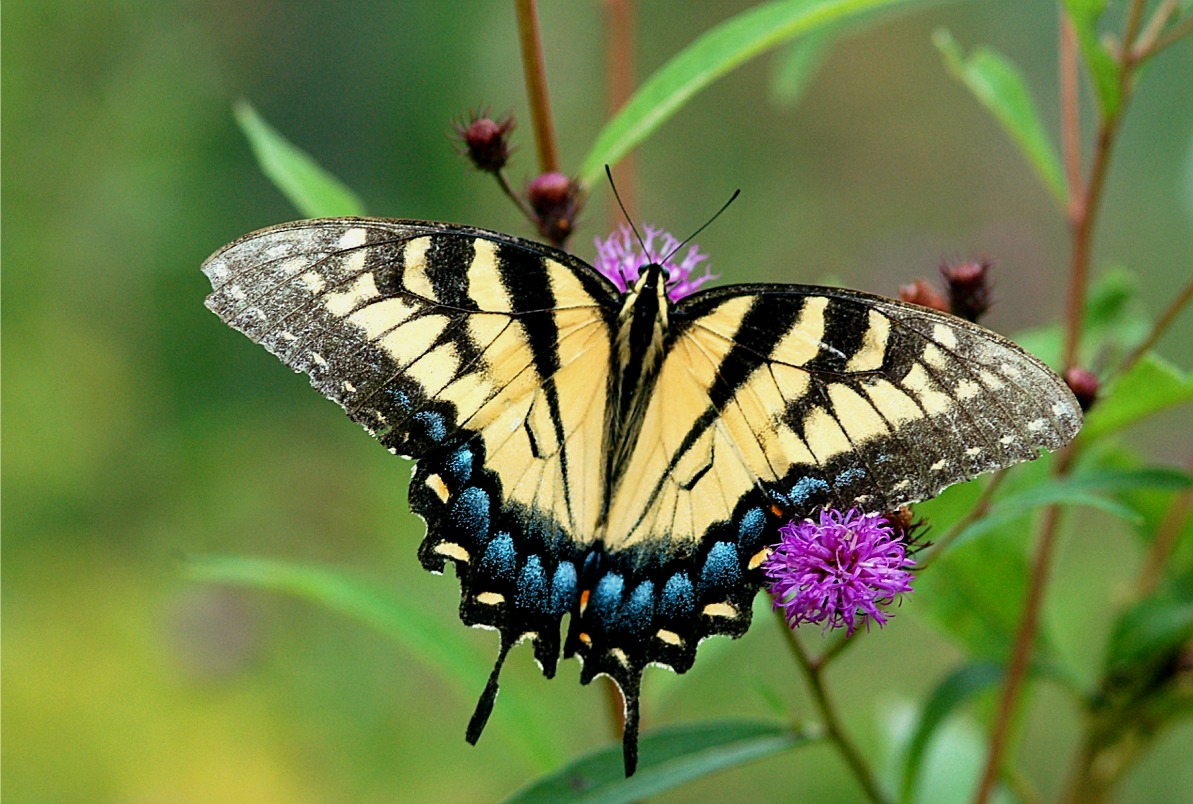
Tim took the honors of Westview, as well, at a Buttonbush (at least, I think that's what it is--I haven't seen it yet), on which he got, all in one fell swoop, Zebra Swallowtail, Tiger Swallowtail (the first of both for the day, though I duplicated them at my end of the park), Silver Spotted Skipper (one of only three on the entire day, a count low for us; compare with a high of 50 one year),
Gemmed Satyr (last recorded on our count in 2001), and Juniper Hairstreak. This is an unusual species for us, but yesterday was the only hairstreak of the day. The photo is of the second individual Juniper Hairstreak, also found by Tim at a site much later in the day, a photo made possible by the use of the cell phones. This is one of my very favorite butterflies, so he called me up to come and see it. (The green background is weird, but it's what came out. Must have been the vegetation in the background, blurred out because of the macro-focus.)


We last recorded Juniper Hairstreak in 2006; the only other time was 2001, and in both of those years we saw only one individual, so we might no have been having a good day overall, but it was a good day for Callophrys gryneus! It was very unusual that we would get no other hairstreaks--commonly we get
Gray Hairstreak and Red-Banded Hairstreak; the only years we didn't were the very early years of the count when we were unfamiliar with the local fauna and ill-adept enough that most of our count consisted of butterflies bigger than a quarter!

I suppose I should confess to a moment of comedy--at least, it would have provided a moment of comedy had there been anyone there to view it besides me. I was poking around in the mud at the edge of a pond in the Powhatan Wildlife Management Area, trying to determine which of several flying things were Buckeyes and which were Snouts (one of the latter got easier to identify when it kept landing on my hat, a distinctly Snout-like behavior), when I suddenly heard, quite clearly, and quite nearby, the hoot of a Barred Owl. I turned to see if I could see it--startled at hearing it in the middle of the afternoon--and I heard it (or another one) louder and behind me. There followed a brief moment of goofiness as I turned round and round, trying to locate the bird by its increasingly loud hooting, when I suddenly remembered that the hooting of the Great Horned Owl is the ringtone I have set on my phone for Tim's calls. The phone was in my backpack, and thus, amazingly, kept moving behind me every time I turned around. Oops. Old Fogey alert. Don't tell my students; I'm sure they would think there is a special place in hell for anyone dumb enough not to recognize her own cell phone ringing. Still, as I got to see the Juniper Hairstreak as a result of the folly, I'll live with the humiliation.

Here's the Snout not on my hat:


Other highlights:

Butterfly Feat of the Day: Tim caught a skipper in his bare hands, without squishing it, and carted it across a field so we could transfer it to a vial (by way of net) for identification purposes. I took two swings at skippers with the net yesterday and missed both times. They don't call 'em "skipper" for nothing. I only wish I had been there to see someone grab one with his bare hands. Amazing.

Real Butterfly Photo du Jour, this one, of a Harvester. This is a gem of a little butterfly. Very pretty, vary rare--at least in our area. Never officially recorded in any part of Central Virginia prior to the beginning of our count; we have now counted it in all three of the counties into which our circle encroaches. Last recorded on our count in 2004. I got the honors of this one: it was puddling in the mud in the one un-drowned patch of river's edge along the James, along with several Eastern Tailed Blues. It was totally serendipitous--no stalking required or engaged. In fact, I didn't even see the thing until I was taking the photos of the Blues. Saw it actually through the camera lens. Here are the blues:


And here is the Harvester:


Even the stripes on his antennae are in focus. That little bug was sitting STILL!

As it turned out, the weather reporters were, much to our great relief and pleasure, wrong again. The day turned out to be nearly perfect for butterfly counting; about 95% sunshine all day, temperatures in the 80s until about 4:00 when it crept up to 91, low humidity, and a light breeze. There was enough sun to dry off the vegetation (and the wet butterfly wings); it was perfect flying weather. And still we weren't getting much. I surmise that this is a good indicator that the crop is down this year; if they weren't flying yesterday, it's because they weren't around! We groused our way through the day, grumbling about how little we were seeing, and how amazed we were about not seeing certain things--it's a rare count when we see more Zebra Swallowtails (4) than
Spicebush Swallowtails (zero), no Wood Nymphs, and three Sachems. (We've had counts, including last year's, with more than 100 of the latter. Last year's tally: 351. We had 100 on one bush last year....). We got only 8 Great Spangled Fritillaries (six of them way at the end of the day in one spot; photo below--both are Great Spangled Fritillary, but one is really beat up!), and only six Tiger Swallowtails--an impressively low number for a bug that has been "Big Bug of the Day" before. Plenty of fodder for grousing here.


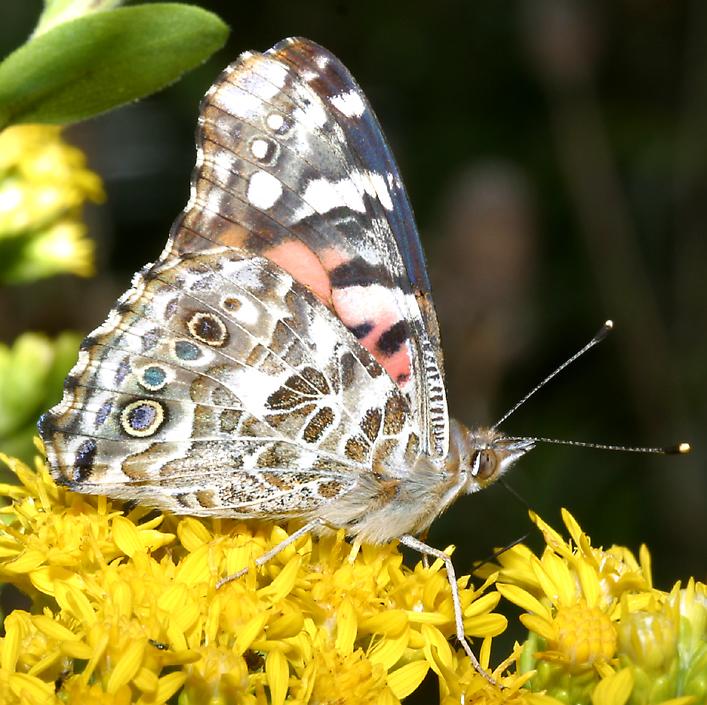
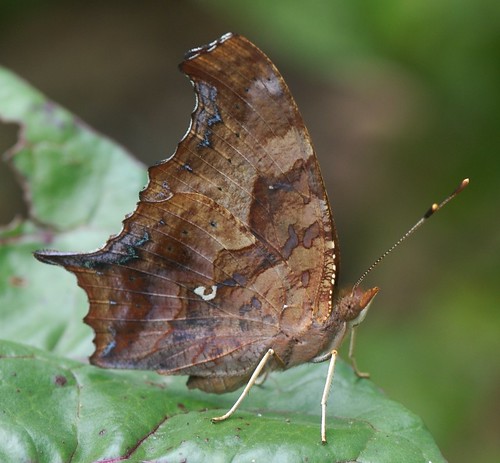
One final insult was that Vanessas were in short, short supply (there are four Vanessas, three of which occur in Virginia--Painted Lady, American Lady, and Red Admiral, and they are a kind of butterfly count barometer, in part due to the possibly apocryphal story of someone in California once nabbing all four Vanessas with one swing of the net). We usually get all three of the locally available species, though never in one swing of the net; indeed, seldom in the net at all, as they are quite speedy little tykes, and never in really large numbers, but we were coming down to the very end of the day yesterday working on two American Ladies and nothing else. We headed down the drive at Powhatan Lakes, the penultimate stop, and hopped out of the car to chase down an anglewing (turned out to be Question Mark). Conversation:

Me: Wasn't it last year that we were driving down this road complaining that we hadn't seen a Red Admiral all day, and one landed more or less on the hood of the car?

Tim: You mean like that one?


Voila, there it was, on the ground behind me.


(Not a great photo, as the little guy never stopped moving, and his wings are blurry, but check out the proboscis! Nicely curled and in focus.)

This would have provided us with endless amazing-coincidence butterfly count stories for years to come, as well as resulting in our forever branding Powhatan Lakes as the spot where we can count on getting Red Admiral, except that it turned out that it WASN'T Red Admiral we got there last year, but
Eastern Comma. So much for memory. This is why we bring pencils. And keep notes. Not more old-foginess: heat-induced delusion. That's my story and I'm sticking to it.

Nevertheless: Powhatan Lakes turned out to be a great stop--we picked up not only the Red Admiral, but also a Spring Azure (see photo below)--the only one on the day. One of the fun things about doing the count is that it is pretty consistently true that no matter how badly things are going, we pick up something new at each site--and something that we don't get anywhere else in the circle. At least makes you FEEL as if it was necessary to go everywhere we go and to spend as much time as we spent!


At the end of the day, we staggered home after 9 1/2 hours (about typical for us), showered, eliminated all ticks--a record high this year of nearly 40, most of them, fortunately running around on t-shirts and jeans looking for entree), and regrouped at Rocco's for the traditional butterfly count compilation dinner. MUCH to our amazement, the compilation revealed that we had done considerably better than we thought. I had estimated 20 species, and we guessed we had maybe 250 butterflies--which was dangerously near the all time lows on both parameters, but lo and behold: we came up with 33 species and 381 butterflies. Evidently, despite our grousing, we had been quietly racking up a decent haul, one little butterfly at a time. Given the things we DIDN'T see, an amazing outcome, even if 105 of them were Eastern Tailed Blues--the littlest bug finished "Big Bug of the Day" for about the 10th or 11th year, followed by
Cabbage White with a respectable showing of 67. Call it an "average" count. Much better than the "abysmal" we had anticipated.

We should have the car unpacked just about the time we have to load it up again for next year's count! Anyone want to join us?

Note: All photos here are pictures I took on yesterday's count. I linked to photos of butterflies for which I did not have photos. You can click on any photo for a larger version--at least you can in Internet Explorer and Flock, the only two browsers I tried.


UPDATE: 7/10/09 Thanks to the Dave Barry Blog, I learn that my goat up a tree is not the only goat up a tree. I wonder if this is common?

Search This Blog

Visitors Since 9/13/08

Followers

Jacquie Lawson

Jacquie Lawson e-cards
Powered By Blogger